How Early Should You Hire an Event Planner?
A practical guide to event planner booking, recommended planning timelines, lead times for weddings and corporate events, and how early professional involvement protects your budget and peace of mind.
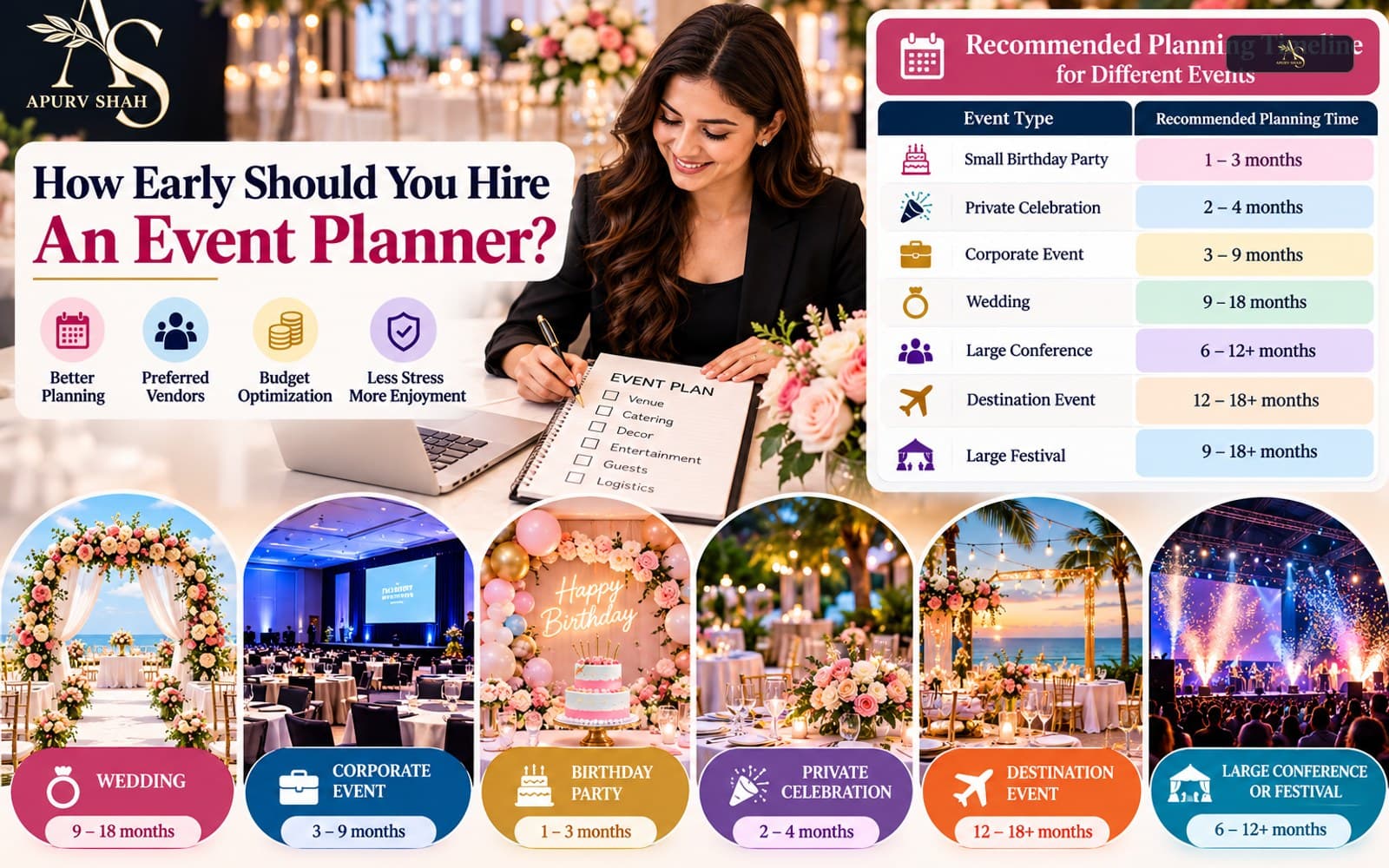
Master event planning booking roadmap: mapping venue lead times, vendor coordination, and milestone timelines.
When Should You Hire an Event Planner?
As a general rule, you should hire an event planner as soon as you have an approximate date and budget—typically 9 to 18 months before weddings and destination celebrations, 3 to 9 months before corporate events and conferences, and 1 to 4 months before private parties. Booking early secures premier venues, avoids expensive rush surcharges, secures first-choice creative vendors, and ensures your entire event is engineered cohesively within your financial framework from day one.
01How Early Should You Hire an Event Planner?
Planning a milestone event is an exhilarating experience, but it can quickly transition from an inspiring dream into a complex logistical labyrinth. Between securing a venue, managing guest lists, negotiating vendor contracts, formulating a realistic budget, arranging sound and lighting production, designing floral décor, and ensuring every single moving part synchronizes on event day, the workload can become overwhelming.
This is why one of the most common questions hosts ask is: when should I hire an event planner?
There is no universal deadline. The ideal event planner booking window depends on the event type, number of guests, destination logistics, budget scale, level of custom fabrication, number of third-party vendors, and how much operational responsibility you wish to retain yourself. A boutique 40-person birthday dinner may be effortlessly organized within a few weeks, while a multi-day luxury wedding, corporate summit, or festival requires many months of disciplined architectural planning.
Event Scale & Guests
Larger guest counts demand earlier venue buyouts and complex hospitality logistics.
Date Desirability
Peak wedding weekends and festive dates book 12 to 18 months in advance.
Custom Production
Bespoke staging, floral installations, and customized branding require longer lead times.
Vendor Availability
Top photographers, master caterers, and renowned artists take only one booking per date.
Destination Factors
Guest travel arrangements, hotel room blocks, and local permits require early alignment.
Personal Delegation
Whether you want full-service guidance from day one or support only with final execution.
The timing of your booking directly dictates the caliber of choices available to you. Starting early provides the leverage to thoroughly compare venues, negotiate transparent contracts, develop a coherent design aesthetic, build a stress-free schedule, and prepare resilient backup plans. While waiting until the final months does not guarantee failure, it undeniably compresses decisions and multiplies stress.
02Why Early Involvement Is Key
Event planning is a deeply interconnected system rather than a random collection of isolated tasks. Every downstream decision is anchored to an upstream decision. Your venue determines your maximum guest capacity, catering kitchen access, floor plan boundaries, sound limits, lighting possibilities, parking flow, and baseline expenditure. If you book a venue before hiring a planner, you may discover restrictive policies that undermine your original vision.
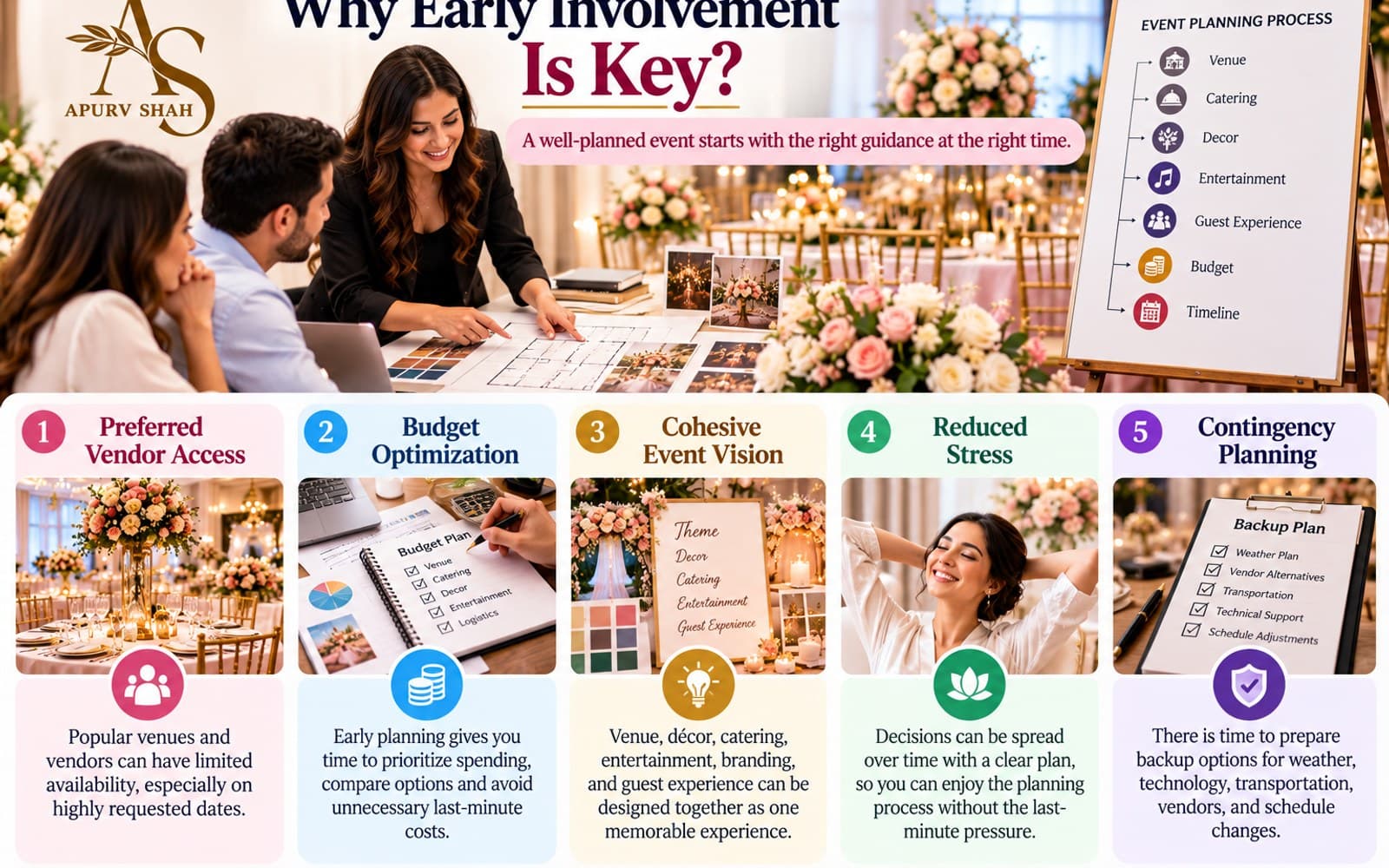
Bringing a professional planner in during the formative stages creates room to anticipate and neutralize bottlenecks before they become costly mistakes:
Preferred Vendor & Venue Access
Premier venues, celebrated photographers, top-tier caterers, and renowned entertainers maintain limited calendars and routinely book 9 to 18 months in advance.
Budget Optimization & Cost Control
Early planning prevents rush delivery surcharges, allows multi-vendor bidding, and ensures expenditures are prioritized around your highest-impact memories.
Unified Aesthetic & Experience
Venue architecture, floral design, tablescapes, lighting schemes, culinary presentation, and music can be engineered together into a seamless visual identity.
Stress Elimination & Phased Decisions
Instead of cramming fifty urgent decisions into the final three weeks, milestones are distributed comfortably across months, preserving the joy of hosting.
Contingency & Risk Architecture
Robust backup options for seasonal weather disruptions, AV system failures, transportation delays, or vendor cancellations can be drafted without haste.
Contract Negotiation Leverage
A seasoned planner evaluates hidden attrition clauses, corkage charges, overtime fees, and load-in penalties before you sign binding agreements.
To explore how planning differs from event-day operations, review our comprehensive breakdown on Event Planner vs Event Manager: What's the Difference?.
03Determining Your Needs: When Should I Book an Event Planner?
The precise answer to when should I book an event planner hinges on the exact scope of responsibilities you intend to delegate. If you desire guidance through the entire lifecycle—sculpting the concept, managing the budget, scouting venues, hiring vendors, and curating design—involving a planner from the outset is invaluable.
Conversely, if you have already contracted the venue, chosen the caterer, and booked the photographer, you may not require full-scale planning. A partial planning package or dedicated event management service may be the ideal fit.
Pre-Booking Self-Assessment
Before reaching out to planners, evaluate where your event stands today:
04When to Hire an Event Planner for a Wedding
Weddings represent some of the most emotionally significant and detail-dense celebrations a host will ever organize. Multiple ceremonies, custom wardrobe changes, elaborate floral mandaps or arches, bespoke stationery, luxury catering, musical choreography, and intricate family dynamics must all converge flawlessly on a single date.
For most couples, beginning the planning conversation 9 to 18 months prior to the wedding date provides the necessary breathing room. For multi-day luxury weddings, destination celebrations in locations like Udaipur, Goa, or Jaipur, or events planned during peak wedding seasons (November through February), booking 12 to 18+ months in advance is strongly recommended.
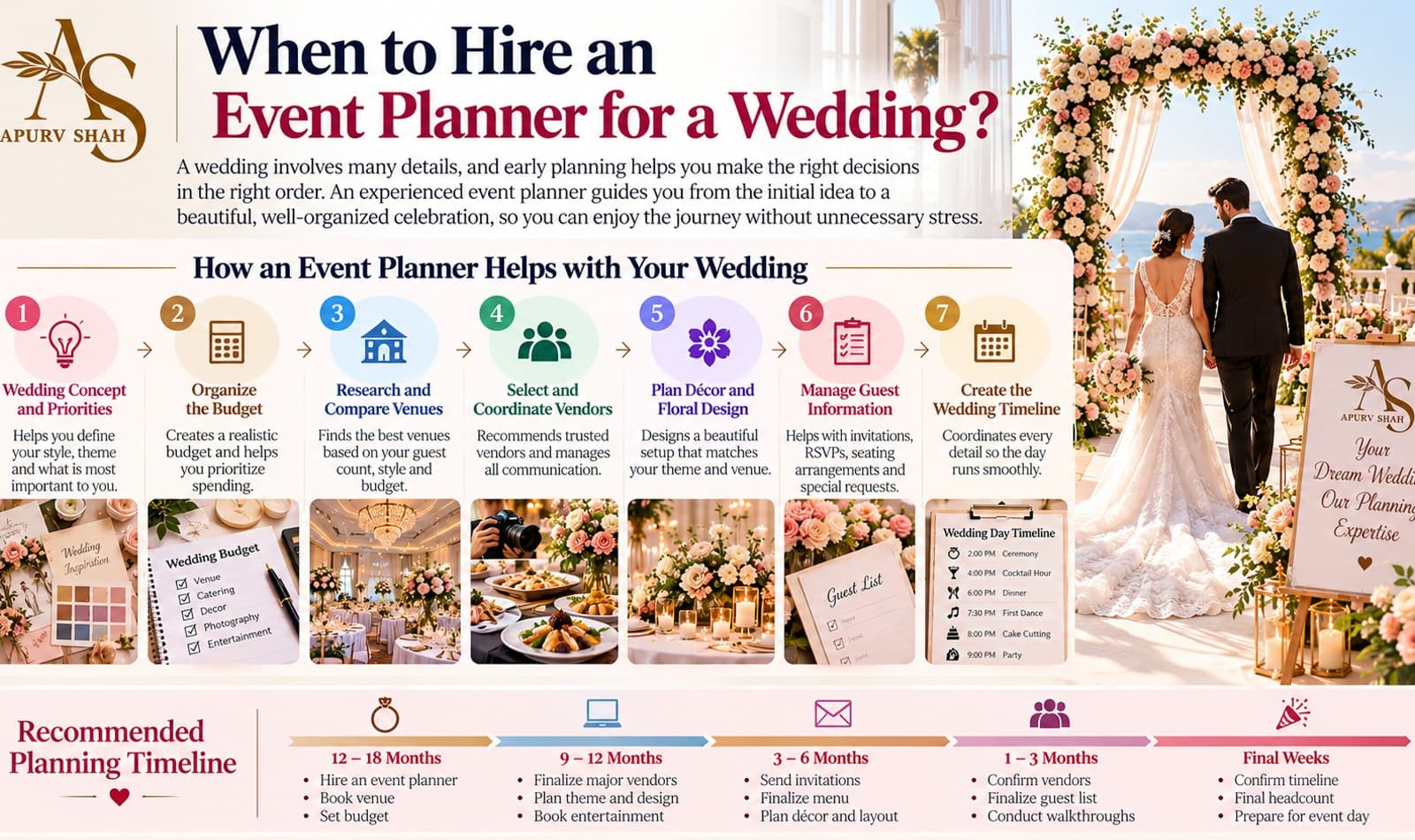
How Early Wedding Planning Protects Your Experience:
- Prevents booking a venue before knowing guest count and budget
- Secures premier photographers and makeup artists with limited calendars
- Allows ample time for custom decor rendering, fabric sourcing, and tasting sessions
- Structures wedding payments across 12 months rather than sudden lump sums
Planning a multi-day celebration? Discover how our team organizes every stage from concept to closeout in our Complete Event Planning Checklist: From the First Idea to Event Day.
05When to Hire a Corporate Event Planner
Corporate events require a distinct approach because the gathering must deliver on strict business objectives, reinforce brand reputation, and ensure high return on investment (ROI). Whether you are organizing an annual industry summit, executive retreat, product launch, gala dinner, or international conference, the stakes are exceptionally high.
Corporate events involve complex staging, keynote speaker management, technical AV streaming, ticketing, sponsor exhibits, branded environments, simultaneous translation, executive VIP security, and multi-track agendas. A corporate event planner integrates these demanding components into one synchronistic timeline.
3 – 9 Months Ahead
Ideal for internal sales kickoffs, milestone anniversary galas, regional award ceremonies, and executive seminars with up to 250 attendees.
6 – 12+ Months Ahead
Necessary for multi-day conventions, international dealer meets, exhibitions, and conferences requiring convention center buyouts, hotel room blocks, and complex AV rigging.
06When to Hire a Planner for a Birthday or Private Event
Not every celebration demands a year of lead time. Milestone birthdays (such as 18th, 30th, 50th, or 75th celebrations), anniversaries, private dinners, engagement parties, and cocktail soirées often operate on shorter planning runways. The complexity of the concept should dictate your timeline rather than the event title alone.
An intimate dinner party for 30 guests at a private estate can be flawlessly arranged within 4 to 6 weeks. However, a luxury 200-guest themed birthday involving a rented ballroom, celebrity DJ, custom immersive décor, professional mixology stations, and cinematography will require 2 to 4 months of coordination.
Private Event Checklist Managed by AS Events:
07Understanding Different Event Planning Services
Every host approaches an event with unique availability, organizational skills, and delegation goals. Professional event companies structure services into distinct tiers so you only pay for the exact level of support you need. Understanding these service tiers clarifies exactly how early you need to book:
Full-Service Planning
End-to-end guidance from initial concept, budget creation, and venue sourcing to vendor contracting, full styling, and live management.
Partial Planning
Designed for hosts who have locked in their venue and initial vendors, but need expert assistance with design, missing vendor gaps, and logistics.
Event Management
Focuses heavily on operational execution, schedule synchronization, staff briefing, and live oversight of pre-contracted vendors.
Event-Day Coordination
Takes over 4–6 weeks prior to the event to audit timelines, confirm vendor load-ins, run rehearsals, and oversee live execution so the host can celebrate.
Compare our service tiers and inclusions on our dedicated Event Services and Event Packages pages.
08Full-Service Event Planning
Full-service event planning delivers total peace of mind from day one. A dedicated planner serves as your trusted advisor, financial steward, creative director, and operational general. Services include budget development, venue scouting, vendor contract negotiations, theme rendering, floor plans, stationery curation, guest RSVP management, run-of-show scheduling, and seamless on-site execution.
Because a full-service planner guides every formative decision, booking 12 months or more in advance is ideal. This generous timeline allows your planner to build your celebration systematically, pit competing proposals against each other to capture best pricing, and craft bespoke elements without the pressure of looming deadlines.
This approach is indispensable for high-profile weddings, multi-day corporate conferences, destination celebrations, and large-scale public galas.
09Partial Planning and Event Management Services
Not every host starts from a blank canvas. Many clients take the initial initiative to book their dream venue, choose a trusted family caterer, or select a favorite photographer, but quickly realize that connecting all the remaining dots is a full-time job. This is where partial planning and event management provide tailored, high-value intervention.
Partial Planning Services
Partial planning bridges the gap between independent planning and full-service support. You retain creative control over the decisions you enjoy, while delegating complex, time-consuming tasks:
- • Sourcing and negotiating missing vendor disciplines (AV, decor, artists)
- • Refining and harmonizing design palettes with venue realities
- • Reviewing signed vendor contracts for logistical gaps or timing traps
- • Creating the master production schedule and floor plans
Event Management Services
Event management focuses primarily on technical coordination and live operational execution. It assumes the major contracts are signed and steps in 4 to 8 weeks before:
- • Conducting thorough on-site technical walkthroughs with vendors
- • Constructing the minute-by-minute event-day run-of-show
- • Managing load-in logistics, vendor access, and parking flow
- • Serving as the single point of contact on event day for all staff
By booking partial planning or event management 3 to 6 months prior to your celebration, you safeguard all the time and capital already invested, ensuring your hard work culminates in a flawless experience.
10Event Day Coordination
Often colloquially called "day-of coordination," this service is designed for clients who have thoroughly enjoyed planning their own event but recognize that hosting and managing are mutually exclusive. On your event day, you should be sipping champagne, greeting guests, or networking with executives—not fielding calls from delivery drivers lost in traffic or troubleshooting a blown microphone fuse.
Professional coordination begins approximately 4 to 6 weeks before the event. The coordinator reviews all vendor agreements, audits load-in schedules, verifies power and sound requirements, and conducts a venue walkthrough. On event day, they serve as central command—supervising setup, enforcing timeline cues, directing staff, and silently resolving hiccups behind the scenes.
We recommend booking your coordinator 2 to 4 months in advance to ensure their date availability, even though their hands-on work begins closer to event day.
11What Happens If You Hire an Event Planner Too Late?
Hiring a professional late in the timeline does not mean your event will collapse—seasoned event directors can perform remarkable turnarounds. However, delayed booking limits your strategic options and introduces avoidable friction:
Restricted Venue Availability
Your first-choice luxury ballroom or garden lawn is frequently booked 12+ months out.
Limited Creative Vendors
Acclaimed photographers, cinematographers, and entertainers cannot duplicate their time.
Premature Budget Exhaustion
Without early planner guidance, budgets are frequently overspent on the venue and catering.
Rush Surcharges
Express fabrication fees for custom stage backdrops, printing, and rentals add substantial cost.
Severe Decision Compression
Dozens of critical decisions get crammed into 2–3 stressful weeks, causing host fatigue.
Truncated Contingency Windows
Less time remains to negotiate alternative outdoor rain setups or backup equipment.
Booking early allows you to act proactively rather than reactively, preserving budget efficiency and mental calm throughout the journey.
12Can You Hire an Event Planner at the Last Minute?
Yes. Last-minute event planning is entirely possible. Whether you have suddenly been tasked with organizing a company conference on short notice, or you are four weeks from your wedding and realize that self-coordinating is impossible, an experienced planner can step in to stabilize the event.
When brought in late, an event professional conducts immediate triage: auditing contracted vendors, standardizing the run-of-show, identifying critical operational oversights, establishing single-point communication, and taking over event-day load-in.
AS Events Rapid Response: Even with only 2 to 4 weeks remaining, professional coordination can transform a chaotic setup into a polished, punctual celebration. Transparency regarding completed items and remaining gaps is key.
13An Ideal Event Planning Timeline
While every celebration should be calibrated to its unique size and complexity, the following 7-stage master sequence represents a proven, professional framework:
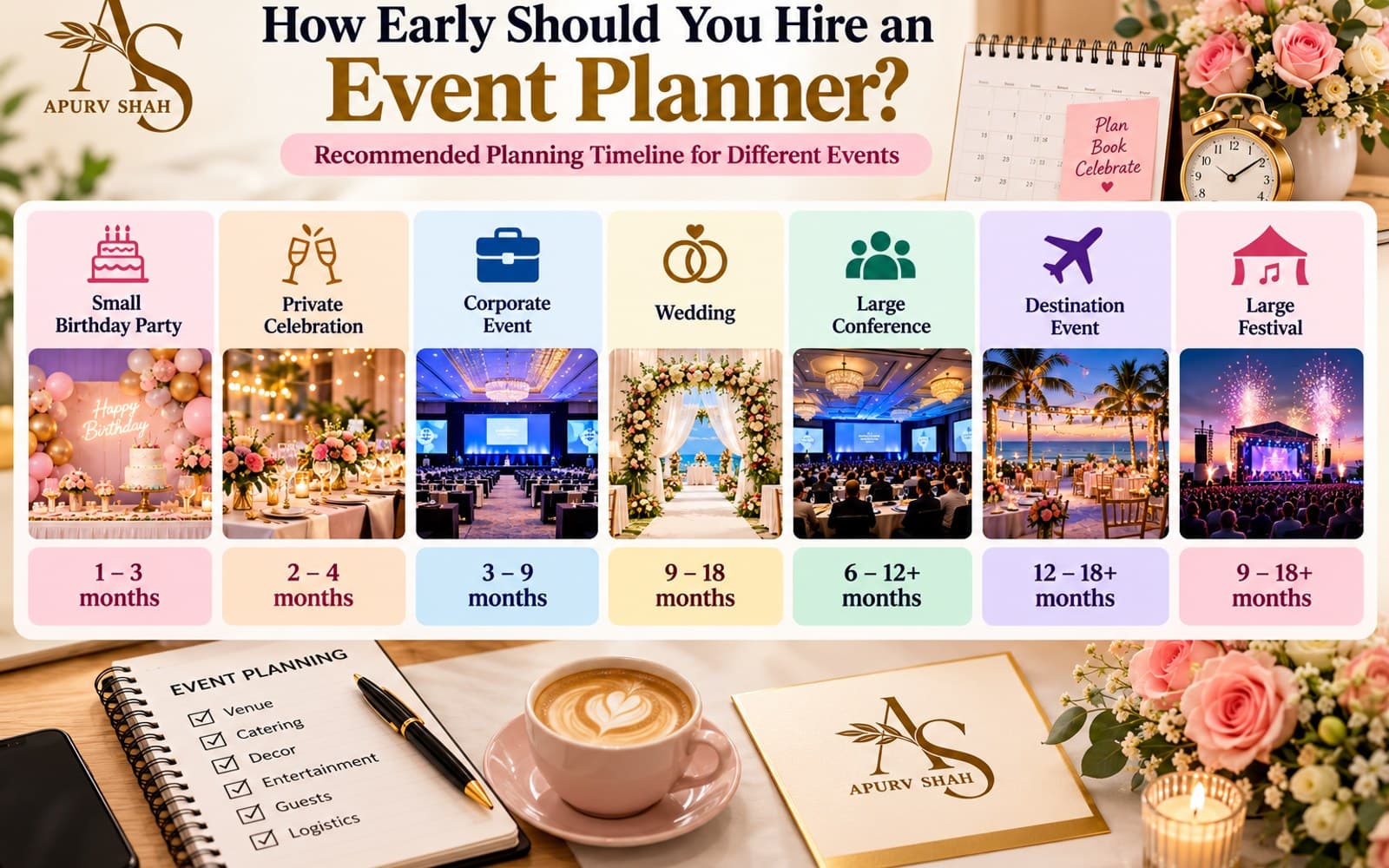
12 – 18 Months Before Roadmap
Define event purpose, establish initial budget boundaries, estimate total guest count, choose target date, research venues, hire your professional event planner, and build the overarching creative concept.
9 – 12 Months Before Roadmap
Confirm the venue, book high-demand primary vendors (photographers, cinematographers, lead entertainment), initiate catering design, and formalize the master multi-month planning calendar.
6 – 9 Months Before Roadmap
Review technical AV and lighting requirements, create guest communication channels and save-the-dates, finalize spatial floor plans, and review expenditures against original budget benchmarks.
3 – 6 Months Before Roadmap
Issue formal invitations, conduct menu tastings, coordinate guest transportation and rooming allocations, review on-site event staff requirements, and draft the preliminary event-day run-of-show.
1 – 3 Months Before Roadmap
Reconcile RSVPs, finalize seating charts, conduct a detailed physical venue walkthrough with key leads, confirm delivery schedules, and synchronize all vendor arrival windows.
Final Weeks Roadmap
Conduct final vendor confirmations, review emergency backup protocols, coordinate ceremony or technical rehearsals, verify deliveries, and assemble event command materials.
Event Day Roadmap
Orchestrate venue load-in, manage vendor setup, direct event staff, maintain schedule fidelity, direct guest flow, handle real-time troubleshooting, and supervise safe strike and breakdown.
14Event Planner Booking Checklist
Before scheduling your initial consultation with a prospective event planning company, prepare the information below. Having these details ready makes your consultation markedly more productive and empowers the planner to provide an accurate proposal:
16 Key Information Points for Your First Meeting:
15How to Choose the Right Professional Event Planner
Selecting an event planner is about far more than just finding someone who happens to be unbooked on your chosen date. Event planning requires intense communication, mutual trust, and shared aesthetic taste.
Relevant Event Portfolio
Verify experience in your specific event category—a stellar wedding planner may not excel at technical corporate expos, and vice-versa.
Transparent Pricing Structure
Ensure total clarity regarding flat management fees, percentage commissions, and whether vendor discounts are passed directly to you.
Vendor Network Strength
Top planners maintain established relationships with dependable caterers, AV production houses, and venues, yielding better terms.
Communication Protocol
Clarify how frequently you will meet, response time expectations, and who your direct day-of point of contact will be.
On-Site Staffing Ratio
Ask how many coordinators and logistical assistants will be physically present on event day to ensure flawless supervision.
Contingency Capabilities
Examine past examples of how the company resolved live crises—such as sudden monsoon downpours or power disruptions.
For an exhaustive list of interview questions and evaluation criteria, read our dedicated guide on How to Choose the Right Event Planner for Your Event.
16Which Event Planning Service Do You Need?
Selecting the ideal service tier is straightforward once you identify your current planning stage:
Still in early concept with nothing booked?
You receive comprehensive guidance from initial budgeting and venue curation to styling, contracting, and live execution.
Venue contracted and some vendors booked?
Fills remaining vendor gaps, audits contracts, refines aesthetic design, and synchronizes logistics into one master plan.
Planning fully complete, but need professional day-of command?
Takes over 4–6 weeks prior to the celebration to orchestrate vendor arrivals, construct the run-of-show, and direct event day.
Organizing a large, multi-day, or high-stakes corporate affair?
Deploy an experienced on-site operations team capable of managing multi-room setups, live streaming, staff, and crisis control.
17How Far in Advance Should You Book an Event Planner?
Use the reference table below to benchmark recommended lead times and booking horizons across different event formats:
| Event Type | Planning Range | Recommended Booking |
|---|---|---|
| Small Birthday Party | 1 – 3 months | 2 months before |
| Private Celebration & Anniversary | 2 – 4 months | 3 months before |
| Corporate Event & Seminar | 3 – 9 months | 4 – 6 months before |
| Wedding Celebration | 9 – 18 months | 12 – 14 months before |
| Large Conference & Summit | 6 – 12+ months | 9 – 12 months before |
| Destination Wedding / Event | 12 – 18+ months | 14 – 16 months before |
| Large Cultural Festival & Gala | 9 – 18+ months | 12 months before |
* Note: Popular seasonal holiday periods, auspicious wedding dates, and major convention weeks demand earlier booking due to limited venue and vendor capacity.
Frequently Asked Questions: Booking Timelines
Expert answers to common questions about booking timelines, lead times, and planner involvement:
The best time to hire an event planner is as soon as you have an approximate date and budget, particularly for large, complex, customized, or date-sensitive events. Involving a planner early gives them the opportunity to help with the foundation of the event—securing preferred venues, establishing realistic budgets, and sourcing trusted vendors before availability tightens.
19Conclusion: Plan Early, Celebrate Completely
The short answer to “how early should I hire an event planner?” is simple: as soon as you recognize that you want your celebration to be exceptional, organized, and free from exhausting stress. While a boutique birthday dinner may only require a few weeks of preparation, weddings, conferences, destination celebrations, and galas benefit immensely from multi-month architectural planning.
Hiring a professional planner early transforms your planning process from a reactive scramble into a joyful, structured creative journey. You secure the finest venues, negotiate with leverage, protect your budget, and guarantee that every creative element connects seamlessly.
“Your event should be something you experience and enjoy — not something you spend the entire day managing.”
Planning an Upcoming Event and Wondering When to Start?
Share your event date, expected guest count, location, and current progress with AS Event Management. We will help you identify the perfect booking window, evaluate vendor lead times, and tailor the ideal planning or management service for your celebration.