
How to Plan a Successful Wedding: A Step-by-Step Wedding Planning Guide
A practical step-by-step wedding planning guide covering budget, guest list, venue, vendors, ceremonies, décor, food, timeline and final wedding-day preparation.

Thoughtful planning and clear coordination transform multi-day wedding celebrations into unforgettable, stress-free family milestones.
Quick Wedding Planning Roadmap
A successful wedding starts with clear priorities, a realistic budget, an organized guest plan, dependable vendors and a practical timeline.
- 1Define your wedding vision
- 2Set the budget
- 3Build the guest list
- 4Choose date and venue
- 5Book key vendors
- 6Plan ceremonies and design
- 7Finalize food, décor and entertainment
- 8Build the wedding-day timeline
- 9Confirm final-week details
Your wedding should feel like a celebration of your story, not an endless list of exhausting decisions. Yet even a relatively intimate celebration can involve several functions, multiple vendors, a substantial guest list, and dozens of strict deadlines. This guide explains how to plan a wedding thoughtfully—from the very first family conversations to the last guest departure—while keeping the experience deeply personal, beautifully organized, and financially realistic.
Use this guide as an adaptable wedding planning checklist. Gujarati, North Indian, South Indian, interfaith, destination, and contemporary weddings each celebrate with unique ceremonies, dietary traditions, and cultural expectations. The goal is to craft a customized plan that honors your heritage and serves your family, rather than forcing your wedding into someone else’s rigid template. If you are exploring comprehensive support, partnering with a professional wedding planner provides the logistical expertise, vendor network, and emotional calm needed for an effortless journey.
1. Start with Your Wedding Vision, Priorities and Guest Experience
Before contacting venues or paying non-refundable deposits, sit down together and agree on what a successful wedding truly means to you and your partner. One couple may dream of a vibrant traditional ceremony surrounded by hundreds of extended relatives; another may envision a smaller, design-focused destination gathering featuring extraordinary culinary artistry and personalized guest details.
Have open conversations covering the overarching atmosphere, likely lineup of functions, preferred geographies, religious rituals, and the degree of involvement each family desires. A clear conversation now prevents conflicting assumptions, last-minute scope changes, and family tension after contracts have already been signed.
Define Your Wedding Vision
Align your ideas before booking vendors or paying deposits
- Discuss preferred atmosphere: intimate, grand, modern, or traditional
- Agree on the lineup of functions: Haldi, Mehndi, Sangeet, Ceremony, Reception
- Determine geographic location: local city ballroom, heritage palace, or beach resort
- Clarify cultural, spiritual, and family traditions with both sides early
Choose Top 3 Priorities
Anchor your budget around what matters most to you both
- Select three non-negotiables (e.g., exceptional food, timeless photography, guest comfort)
- Use priorities to resolve budget trade-offs quickly and decisively
- Curate a focused mood board matching your season, venue, and realistic budget
- Treat inspiration images as creative direction rather than an expensive shopping list
Plan the Guest Experience
Ensure hospitality, accessibility, and effortless guest flow
- Provide step-free access, comfortable seating, and shade for elderly relatives
- Coordinate dedicated accommodations and welcome transport for out-of-town guests
- Plan thoughtful spaces and dining arrangements for families with young children
- Build realistic travel and transition buffers between ceremony and banquet spaces
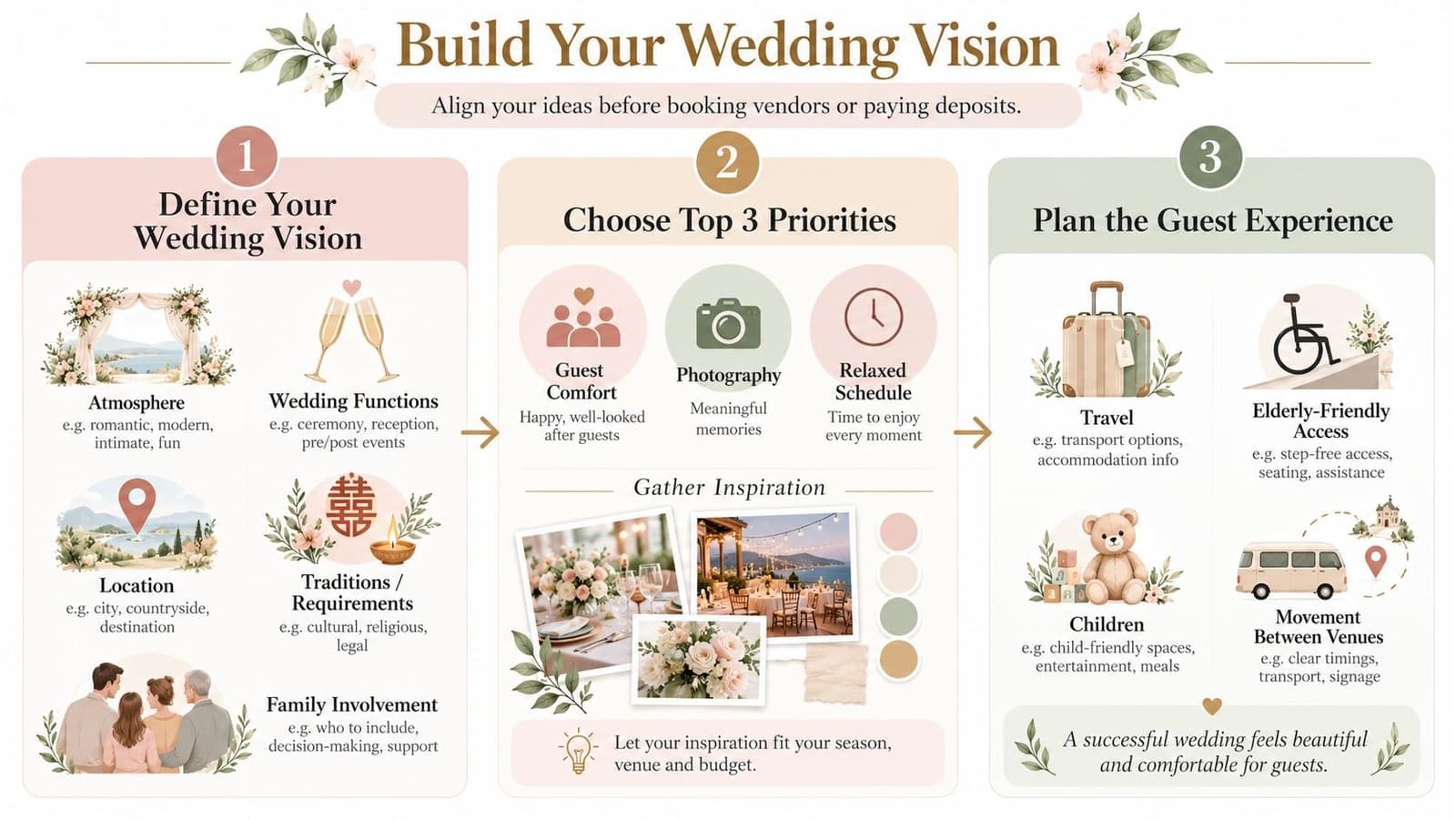
Turn that unified vision into three clear non-negotiable priorities. For example, your top three might be convenient step-free access for grandparents, timeless cinematic photography, and an unhurried ceremony schedule. When budget choices arise later, these priorities will tell you immediately where to invest and where to simplify.
Guest hospitality must receive top priority from day one. Consider whether out-of-town guests require airport transfers, how elderly relatives will navigate outdoor lawns, what dietary options are required for Jain or vegan attendees, and whether transit between venues is seamless. A visually spectacular wedding is only successful if your loved ones can arrive, celebrate, dine, and rest in complete comfort.
2. Set a Realistic Wedding Budget and Control Costs
A realistic wedding budget is grounded in funds that the couple and contributing families have actually agreed to spend. Keep confirmed financial contributions completely distinct from hoped-for support. Establish a firm financial ceiling early, then allocate it across the essential categories: venue, catering, guest accommodations, décor, photography, attire, jewelry, entertainment, transportation, invitations, ceremony materials, and professional coordination.
In Indian weddings, expense distribution varies widely based on guest count, geographic region, and personal preferences rather than rigid generic percentages. Review our detailed guide on how to create an event budget for practical spreadsheets, category trackers, and expense formulas.

Essential Rules for Wedding Cost Control
- Demand itemized written quotes: Ensure proposals include taxes, service charges, power backup, and overtime.
- Account for decor labor: Verify whether styling quotes cover transport, rigging, installation, and late-night teardown.
- Maintain a 10%–15% contingency buffer: Protect your finances against unexpected weather shifts or guest count surges.
- Conduct weekly budget audits: Compare contracted numbers against preliminary estimates as RSVPs lock in.
3. Create Your Guest List, Select a Date and Choose the Right Venue
Your guest list directly determines your required hall capacity, catering minimums, room blocks, and print materials. Draft a master guest list together with both families before signing any venue contract. Categorize attendees into immediate family, extended relatives, close friends, professional colleagues, and tentative additions.
Critically, estimate attendance for each ceremony separately. An intimate Mehndi or Haldi gathering might host 80 guests, a high-energy Sangeet 200, and the Wedding Ceremony and Reception 350 to 500 guests. Keeping guest responses in a unified master tracking sheet with designated family coordinators ensures seamless RSVP management.
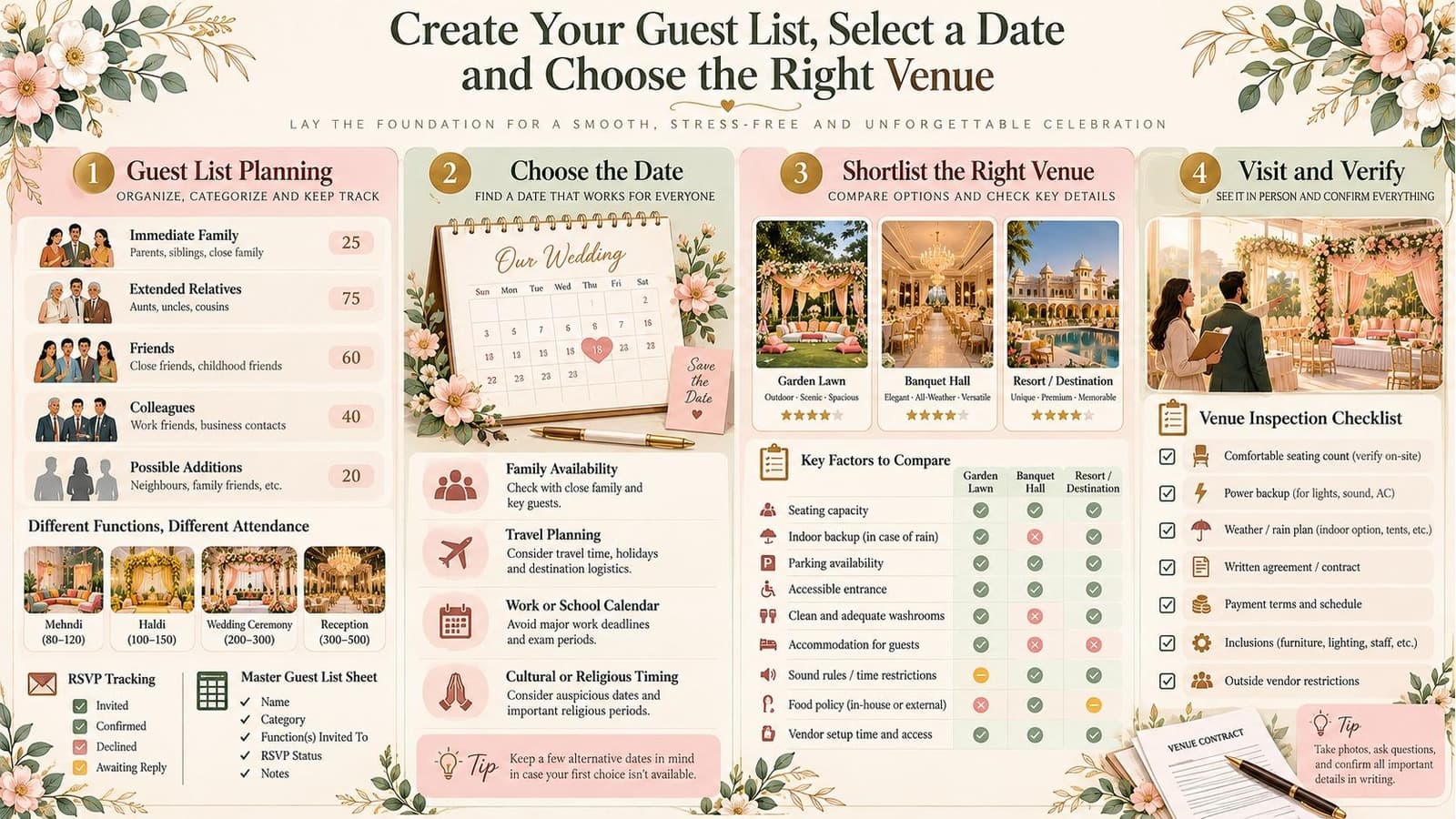
Key Date Selection Factors
- • Auspicious Timings (Muhurat): Align dates with cultural or Vedic calendars.
- • Family Availability: Confirm key relatives, elders, and travelers can attend.
- • School & Work Calendars: Avoid major exam seasons and corporate quarter-ends.
- • Seasonal Weather: Account for monsoon risks, summer heat, or winter frost.
Critical Venue Inspection Criteria
- • Usable Seating Capacity: Mandap and stage setups reduce advertised space by 20–30%.
- • Weather Backups: Ensure banquet halls or weatherproof marquees exist for outdoor lawns.
- • Power Backup & AC: Verify silent generator capacity for intensive lighting and cooling.
- • Access Policies: Check vendor setup hours, outside catering rules, and sound curfews.
If you are evaluating picturesque destination locations across Rajasthan, Goa, Gujarat, or international resorts, explore our dedicated destination wedding planning services for hospitality logistics, room block negotiations, and cross-border vendor management.
4. Choose Trustworthy Wedding Vendors and Plan the Ceremonies
A dependable vendor collective does far more than supply services: they coordinate timing, solve unexpected challenges, and protect the atmosphere of your celebration. Prioritize booking high-demand vendors whose dates fill 9 to 12 months in advance—especially caterers, photographers, venue decorators, sound technicians, and celebrity entertainers.
Always request portfolios featuring real weddings of comparable scale. Confirm the exact name of the lead supervisor who will be physically present on-site during your wedding, and verify equipment redundancy, overtime rates, and cancellation policies before making deposit payments. For guidance on booking timelines, read our guide on how early to hire an event planner.
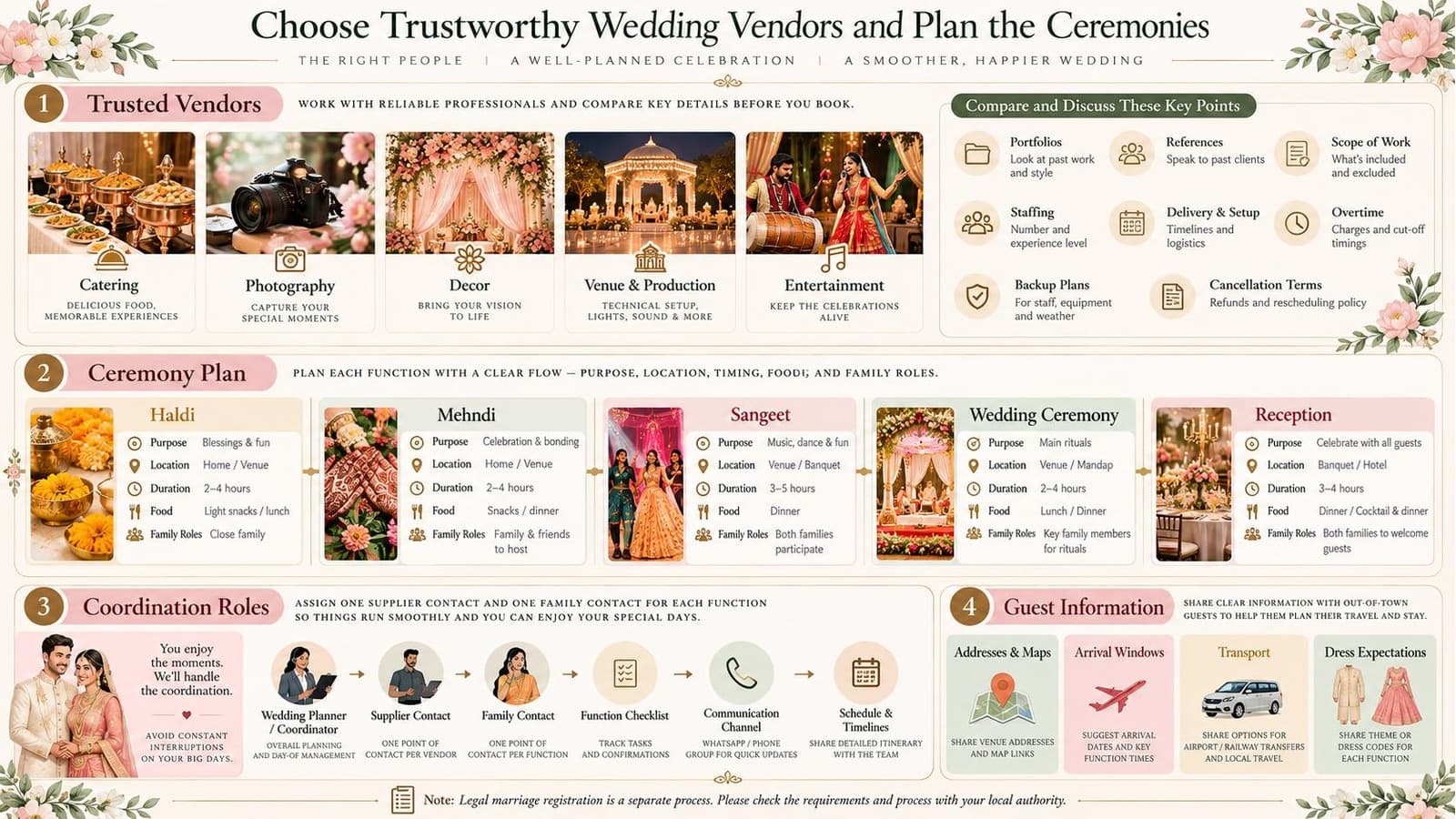
Structuring the Multi-Day Wedding Ceremonies
Indian weddings are renowned for rich multi-day rituals. Rather than squeezing sacred customs between vendor schedules, design a distinct operational flow for each celebration:
Haldi
2 – 3 hours (morning) • Home courtyard, poolside terrace, or lawnAuspicious purification ritual with turmeric, blessings, joyful music, and fun
Mehndi
3 – 4 hours (afternoon or early eve) • Home, banquet terrace, or intimate lawnIntricate henna application, celebration, bonding, folk songs, and photography
Sangeet
4 – 5 hours (evening) • Grand ballroom, resort amphitheater, or clubEnergetic musical extravaganza, choreographed dances, DJ, and family performances
Wedding Ceremony
2 – 4 hours (based on traditions) • Mandap pavilion, heritage courtyard, or temple hallSacred wedding rituals (Mandap, Varmala, Pheras, Kanyadaan) and spiritual vows
Reception
3 – 4 hours (evening) • Pillarless luxury ballroom, palace lawn, or glass pavilionFormal grand celebration, felicitation, wedding portraits, speeches, and dinner
Note: Legal marriage registration is an essential official process distinct from cultural ceremonies. Confirm documentation, affidavits, local registrar office appointments, and witness requirements well in advance.
5. Design the Celebration: Outfits, Décor, Food and Entertainment
Once major dates, venues, and anchor vendors are confirmed, dive into the creative design layers that give your wedding warmth, elegance, and distinct character.
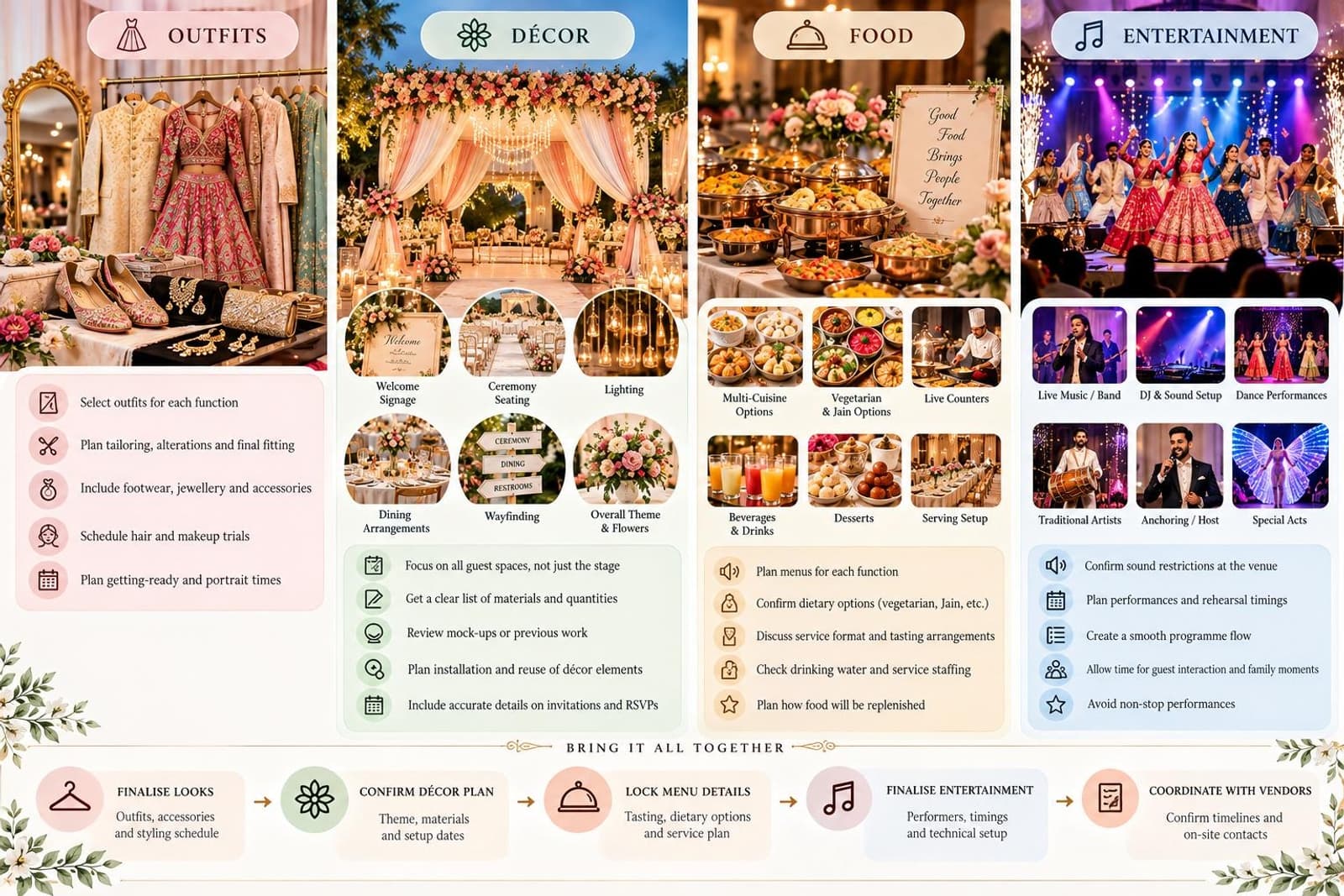
Outfits & Beauty Styling
- • Function-by-Function Attire: Balance color coordination across ceremonies with comfort for heavy embroidery.
- • Tailoring Timelines: Allow 8–12 weeks for bespoke tailoring, alterations, and jewelry pairing.
- • Hair & Makeup Trials: Test looks with your dupatta draping and lighting conditions.
- • Getting-Ready Schedule: Allocate 3+ hours for bridal styling before early morning rituals.
Décor & Guest Spaces
- • Comprehensive Space Design: Design welcome arches, mandap pavilions, photo zones, and dining areas.
- • Lighting & Atmosphere: Incorporate warm architectural up-lighting, fairy lights, and pin-spots.
- • Smart Element Repurposing: Transition stage florals or lounge furniture between functions to optimize budget.
- • Signage & Wayfinding: Provide clear directional signs for restrooms, dining halls, and ritual areas.
Culinary Excellence
- • Curated Menu Profiles: Contrast street-food chaat at Mehndi with royal thalis or multi-cuisine reception spreads.
- • Dietary Accommodations: Ensure dedicated Jain, vegetarian, and allergen-safe preparation lines.
- • Hydration & Service Staff: Maintain continuous water replenishment and adequate servers per table.
- • Live Food Counters: Interactive counters entertain guests while serving fresh, hot delicacies.
Entertainment & Flow
- • Sound Restrictions: Verify outdoor decibel limits and strict 10:00 PM neighborhood curfews.
- • Sangeet Rehearsals: Run technical stage rehearsals and sound checks prior to guest arrivals.
- • Balanced Programming: Leave generous pauses for family conversation rather than unbroken performances.
- • Engaging Emcee: A professional host keeps transitions smooth and audience energy warm.
6. Build a Practical Wedding Planning Checklist and Timeline
A wedding planning checklist is only effective when every single task has an assigned owner, clear deliverables, and a firm deadline. Maintain one master digital document with signed contracts, floor plans, vendor contacts, and payment milestones. Having one single source of truth prevents conflicting versions circulating across extended family WhatsApp groups.
Interactive Wedding Checklist
Click items to mark progress- Define overall wedding vision and scale with partner and familyDiscuss atmosphere, guest size, and must-have cultural elements.
- Establish confirmed financial ceiling and funding contributionsKeep promised contributions separate from tentative support.
- Select top 3 experiential prioritiesGuides budget allocation between venue, catering, decor, and photography.
- Draft preliminary guest lists across both families by functionDifferentiate attendance between Mehndi, Wedding, and Reception.
- Shortlist and tour venues; inspect usable seating and weather backupsVerify sound curfews, catering rules, and load-in access.
- Lock wedding dates and sign written venue agreementConfirm deposit schedule, cancellation terms, and tax inclusions.
- Hire professional wedding planner or coordination teamPlanners negotiate vendor scope and streamline multi-day logistics.
- Book marquee wedding photographer and cinematographerReview full wedding galleries, drone coverage, and editing timelines.
- Contract wedding decorator and production partnerRequest itemized material lists, 3D renders, and lighting schematics.
- Confirm catering team and schedule preliminary tastingsPlan separate menus for each function with Jain and dietary options.
- Book entertainment, DJ, sound engineer, and ritual officiant / priestConfirm sound licenses, rider technical gear, and rehearsal dates.
- Select and order bridal, groom, and family attire for all functionsAllow 8 to 12 weeks for custom embroidery, tailoring, and trials.
- Book hair, makeup, and draping artists with trial sessionsPlan realistic getting-ready slots for early morning ceremonies.
- Finalize invitation design and distribute Save-the-DatesInclude itinerary, venue map links, dress codes, and RSVP deadlines.
- Block hotel room allocations and arrange out-of-town guest transitDesignate airport greeting teams and shared shuttle schedules.
- Design custom floral concepts, stage backdrops, and wayfinding signageExplore repurposing elements across ceremonies to control waste.
- Track incoming RSVPs and lock final meal guarantees with catererAvoid paying for unconfirmed guests by updating numbers weekly.
- Conduct final outfit fittings with footwear and accessoriesBreak in wedding shoes to ensure all-day comfort.
- Review complete ritual requirements and sacred items with the officiantPrepare pooja samagri checklist and assign family custodians.
- Draft master day-of timeline with vendor load-in and ceremony buffersCirculate draft schedule to family leaders and key vendors for review.
- Verify marriage registration legal requirements with local authoritiesEnsure all documentation, affidavits, and witnesses are prepared.
- Reconfirm delivery schedules and on-site contacts for all vendorsEnsure vendors have the name and phone number of your coordinator.
- Assemble wedding-day emergency kitPack safety pins, sewing kit, stain wipes, chargers, hairpins, and meds.
- Review final payment balances and prepare scheduled disbursementsKeep cash or digital authorization ready for contractual balances.
- Assign single family contact per function to assist the coordinatorShields the couple from routine operational interruptions.
- Relax, celebrate, and immerse yourselves in the sacred celebrationTrust your prepared plan and professional team to manage the details.
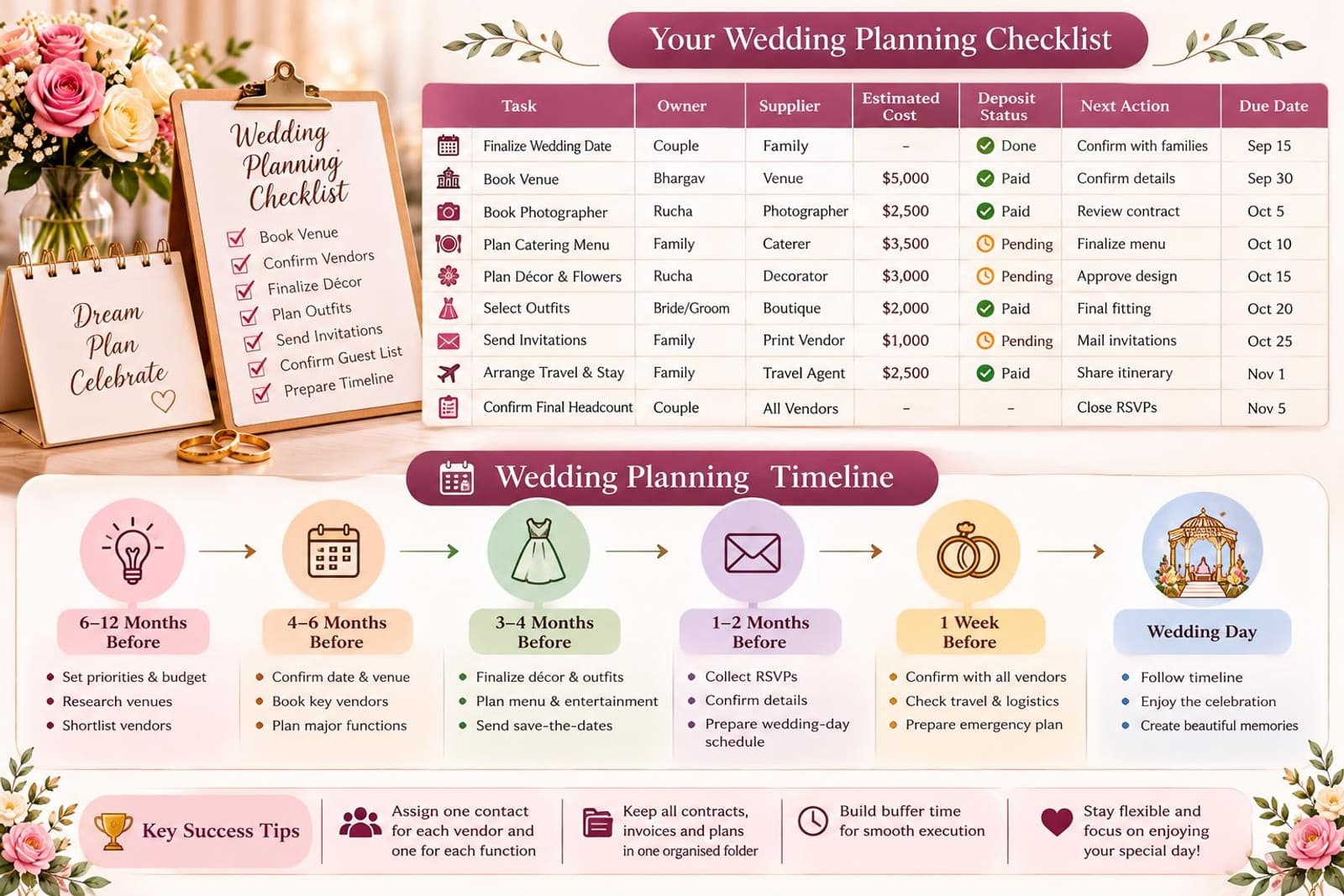
Building the Master Wedding-Day Timeline
On the wedding day itself, time moves faster than anticipated. Build a master minute-by-minute itinerary outlining vendor load-in, room readiness, makeup styling, bridal portraits, baraat arrival, ritual milestones, dining service, and teardown. Always incorporate 30- to 45-minute buffer periods between segments to absorb traffic delays, extended photo sessions, or spontaneous family moments without derailing the evening.
7. Final Checks and When a Wedding Planner Can Help
During the final 7 to 10 days before the wedding, shift from planning to execution readiness. Reconfirm all bookings in writing, reconcile final guest headcounts with catering and seating, review remaining balances, and distribute venue entry passes and parking instructions.
The Essential Wedding Day Emergency Kit
Keep a dedicated kit in the bridal and groom suites containing safety pins, sewing kit with varied thread, double-sided fabric tape, stain remover wipes, spare jewelry fasteners, compact mirror, breath mints, phone chargers, power banks, bottled water, pain relievers, band-aids, and blotting paper.
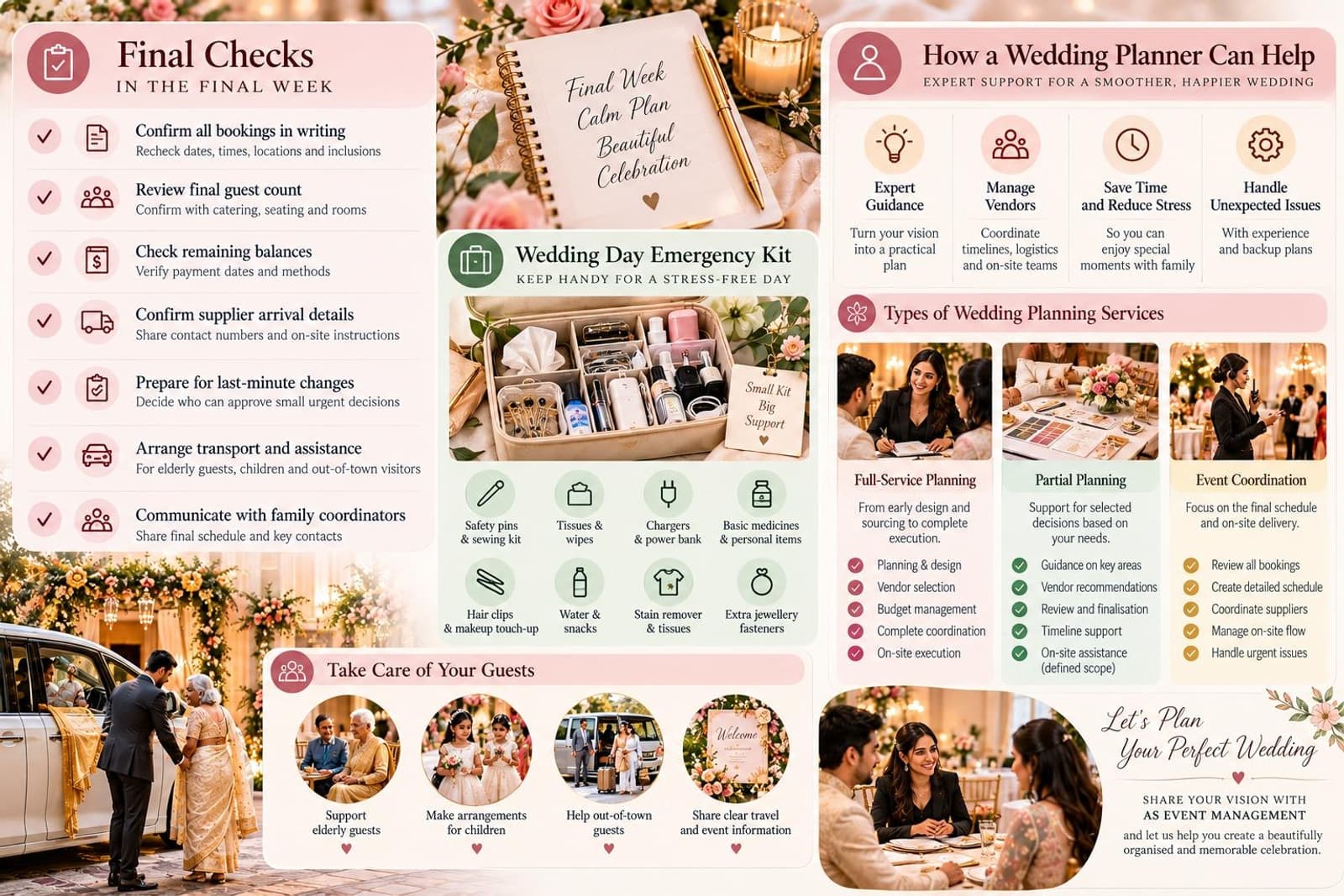
Choosing the Right Planning Support Model
While many couples enjoy planning early creative details, professional wedding planning services become invaluable when managing multi-day festivities, extensive vendor rosters, large guest counts, or destination logistics. Understanding the difference between planning models ensures you select the exact level of support needed:
Complete End-to-End Execution
Comprehensive support from initial concept, budget modeling, venue scouting, and custom decor design to complete vendor contracting, guest hospitality, and multi-day live on-site management.
Targeted Guidance & Sourcing
Ideal for couples who have booked their venue but require professional guidance navigating technical AV, complex catering negotiations, theme styling, and timeline structure.
Live On-Site Delivery
Focuses on the final 4 to 6 weeks, auditing existing vendor contracts, assembling the master timeline, supervising setup load-in, directing ceremony flow, and troubleshooting day-of emergencies.
For a detailed comparison of roles and responsibilities, explore our guide on event planner vs event manager and learn how to choose the right event planner for your event.
8. Conclusion
A truly successful wedding is never measured by how expensive or extravagant the floral arches were; it is defined by how deeply meaningful the celebration felt and how thoroughly cherished your family and guests felt throughout the days spent together.
By anchoring your plans around a shared vision, setting a disciplined budget with room for unexpected needs, selecting dependable vendor partners, and honoring cultural rituals with thoughtful pacing, you liberate yourselves from last-minute panic. With deliberate preparation, you can step back, embrace your loved ones, and savor every sacred, joyful second of the celebration.
Frequently Asked Questions About Planning a Wedding
Explore Related Event Planning Resources
Continue organizing your celebration with our practical planning guides:
Planning Your Wedding and Need Professional Support?
Share your wedding date, location, guest count, functions, priorities and current planning stage with AS Event Management. Our team can help you understand the right planning support for your celebration.