
How Much Does Event Planning Cost in India?
Understand event planning costs in India, including venue, catering, décor, production, planner fees, hidden charges and practical budgeting examples.
Quick Answer: How Much Does Event Planning Cost in India?
There is no single nationwide fixed rate for event planning in India. Two celebrations with identical guest headcounts can have completely different budgets based on city tier, season, venue category, and production complexity. An intimate celebration at a local banquet hall differs dramatically from a multi-day luxury wedding or high-stakes corporate conference.
Professional event planner fees in India typically range from fixed project management fees for clear scopes to percentage-based models (often 10% to 15% of managed spend in full-service weddings) or service-specific coordination retainers. Rather than trusting arbitrary online price promises, establishing an accurate event budget begins with defining your specific event brief and requesting itemized, local supplier quotations.
1. What Determines Event Planning Cost in India?
Every realistic event budget starts with an explicit event brief: the occasion, intended outcome, expected guest attendance, preferred dates, and desired scale. Rather than a mysterious single price tag, the total investment is governed by four deeply interconnected cost drivers.
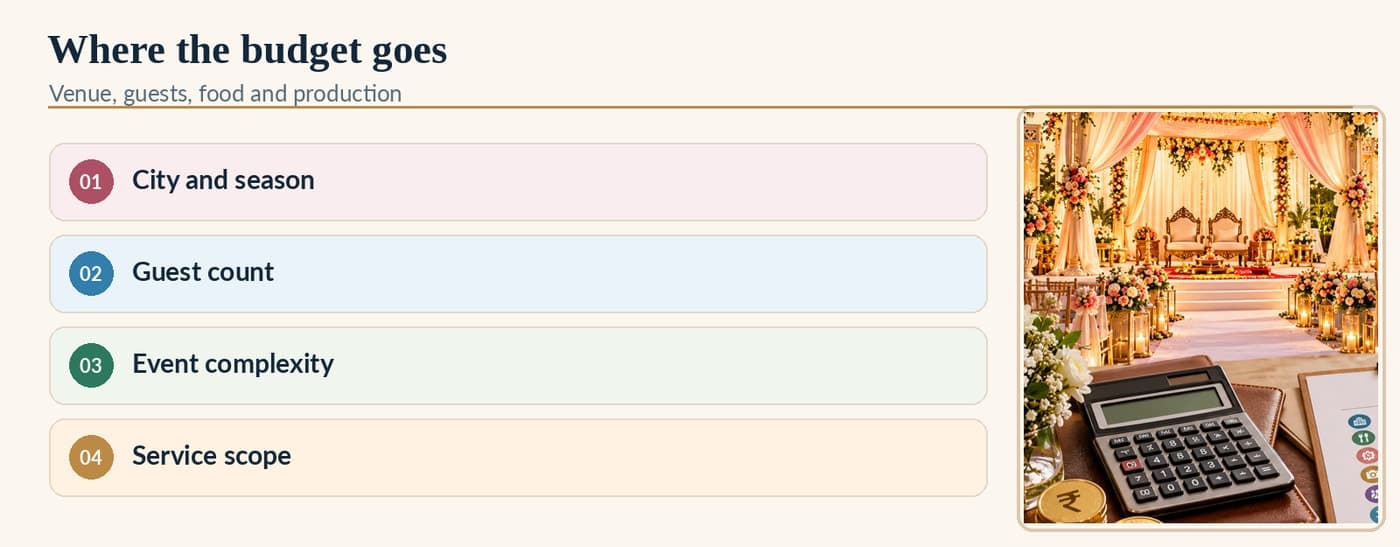
Location, City Tier & Season
Geography and seasonal demand heavily influence vendor and venue rates
- Tier 1 metros (Mumbai, Delhi NCR, Bengaluru) command premium venue rates compared to Tier 2 or 3 destinations.
- Peak wedding and festival months (November to February) create high demand for top venues and creative vendors.
- Off-peak and monsoon dates often offer negotiable venue rentals and flexible vendor scheduling.
- Accessibility, freight logistics, and out-of-station travel surcharges impact destination celebrations.
Guest Count as the Master Multiplier
Headcount dictates every per-person operational expenditure
- Catering is calculated per plate, multiplying food and beverage costs with every added guest.
- Venue square footage requirements, table counts, linen rentals, and floral arrangements expand with guest volume.
- Transport coordination, airport transfers, hotel room blocks, and hospitality staffing scale directly with headcount.
- Guest welcome hampers, stationery, printed place cards, and personalized favors multiply per attendee.
Event Scope & Technical Complexity
The gap between a simple gathering and a multi-stage production
- A simple floral entrance contrasts sharply with custom structural staging, curved LED backdrops, and motorized trussing.
- Sound reinforcement requirements shift drastically between a 50-person family dinner and a 1,000-person concert-grade Sangeet.
- Multiple ceremonial spaces (Haldi courtyard, Sangeet ballroom, Mandap lawn) require separate setup crews and equipment.
- Generators, heavy cabling, licensed pyrotechnics, and intelligent moving-head lighting add specialized technical costs.
Service Scope & Professional Support
Level of coordination, team size, and management responsibilities
- Full-service end-to-end planning covers conceptualization, vendor sourcing, negotiation, budget oversight, and on-site execution.
- Partial planning or month-of coordination steps in after major venues and suppliers have already been booked.
- On-site event coordination focuses purely on managing schedules, vendors, and guest flow during the event days.
- Agency team size, dedicated event leads, and out-of-town management influence professional service pricing.
Understanding how these drivers interact helps you avoid unexpected surprises. For example, selecting a luxury five-star hotel doesn't just increase venue rental; it often requires using mandatory in-house catering with higher per-plate minimums and strict vendor royalty charges for external decorators.
2. Venue Rental and Location: Compare the Full Proposal
The venue controls virtually every operational parameter of your event: usable floor space, stage sightlines, kitchen accessibility, loading bay timing, air conditioning hours, sound decibel curfews, and municipal safety clearances.
The Venue Quotation Trap: Bare Hall vs. Inclusive Package
Consider a 150-person evening social reception evaluating two competing venue options:
Quotes a tempting base rental of ₹1,00,000. However, the contract excludes generator diesel (₹35,000), security deposit (₹50,000), outside caterer kitchen royalty (₹40,000), and air-conditioning beyond 4 hours (₹12,000/hr).
Quotes ₹2,20,000 upfront. Includes full banquet hall access, 8 hours of climate control, dual diesel generators with fuel, green rooms, basic stage, banquet tables, and dedicated housekeeping crew.
Always request itemized venue terms detailing load-in hours, sound curfew times, vendor royalties, and GST rates (typically 18%) before signing.
3. Guest Count: The Most Important Variable to Control
Guest count is not simply a headcount; it is the master multiplier of your entire event budget. Every additional attendee compounds food consumption, table linens, chair rentals, floral centerpieces, service waiters, welcome kits, and transportation requirements.
Initial Invited Count
Total guest list of all invited family, friends, or delegates. Typically sees 15% to 25% attrition depending on travel distance and dates.
Realistic Expected Count
Active RSVPs who have reconfirmed attendance. This realistic number is used to size venue seating, transport, and room allocations.
Guaranteed Minimum
The strict contract number given to caterers and venues 7 to 14 days prior. You are billed for this count even if fewer guests attend.
4. Catering and Food: Calculate the Real Serving Cost
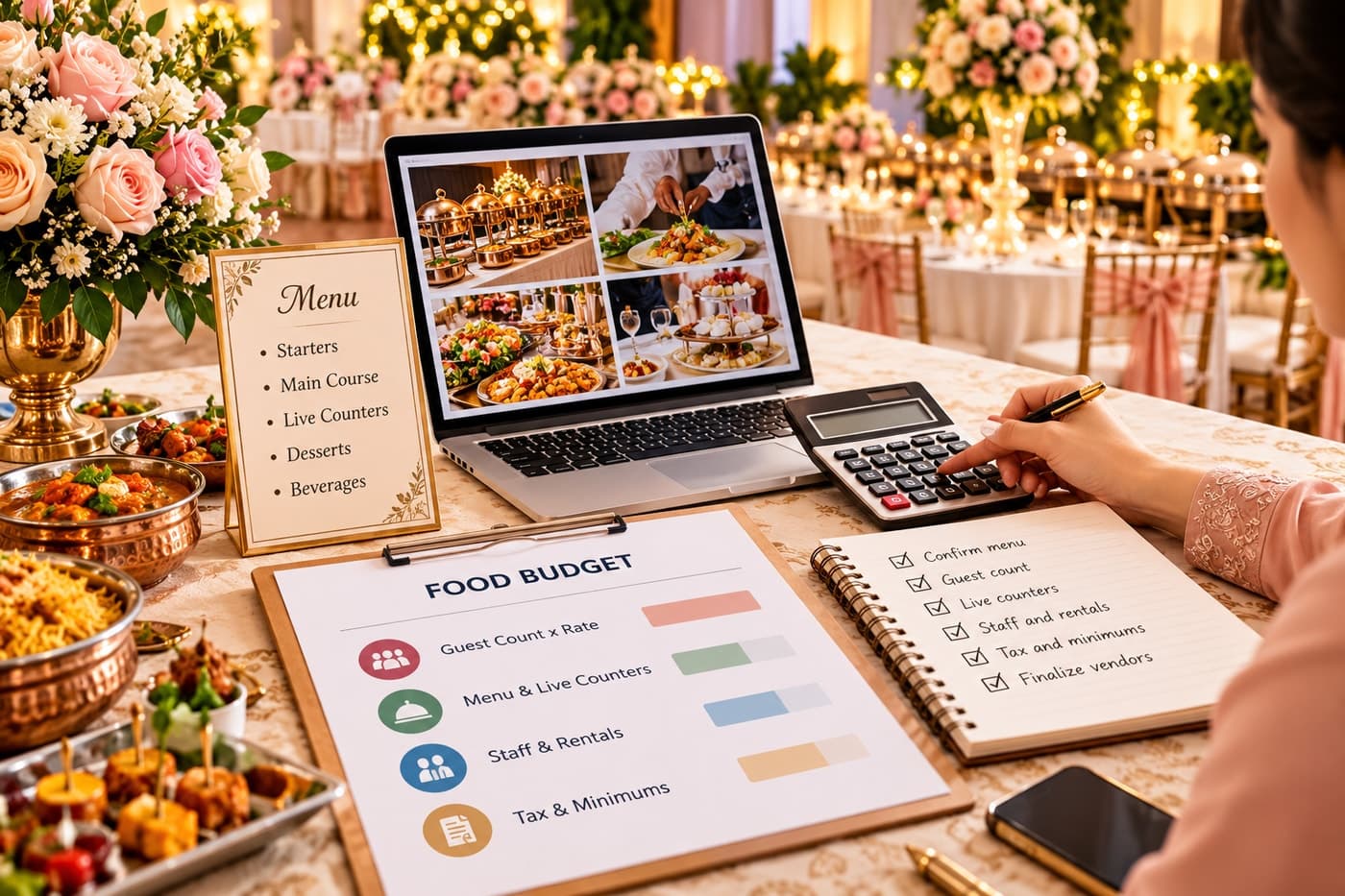
In Indian celebrations, culinary hospitality is the single most remembered element. Whether planning a traditional regional feast, a lavish multi-cuisine buffet, live artisanal cooking counters, or corporate banquet spreads, food normally accounts for 25% to 35% of overall event investment.
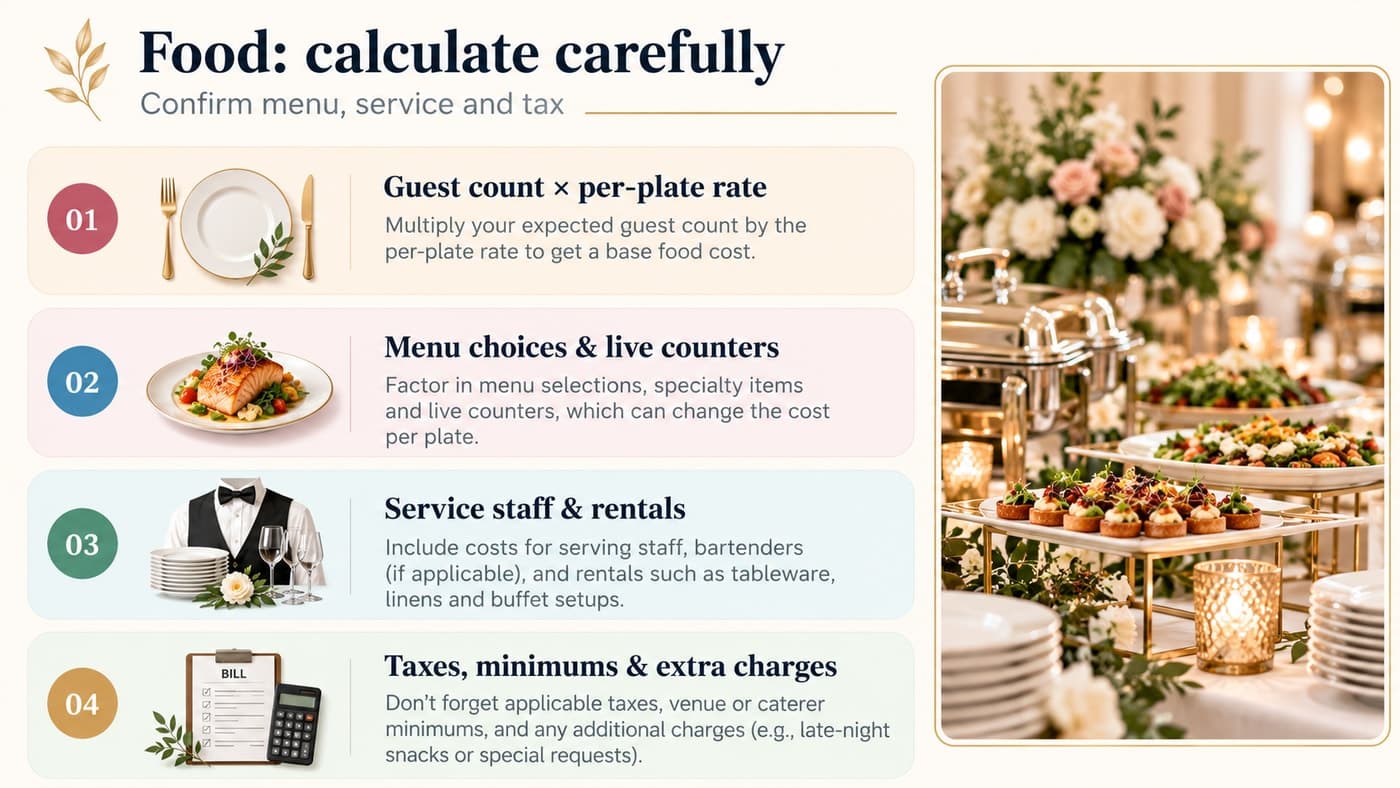
The Practical Event Catering Formula
- Menu Curating: Focus on 4-5 signature high-quality items rather than 20 mediocre dishes that drive up waste.
- Corporate Programs: Align food breaks with keynotes to prevent cold food and long registration bottlenecks.
- Staff Ratio: Ensure a minimum of 1 server per 20–25 banquet guests for seamless hospitality.
- Beverage Logistics: Clarify corkage fees, bartending licenses, and ice/chiller inclusions in writing.
5. Décor, Entertainment and Technology: Choose What Serves the Event
Great décor and technical production create the emotional atmosphere of an event. However, over-decorating without considering operational flow can waste money and cause delays. A smart budget establishes a clear hierarchy of needs:
Operational Foundation
Crystal-clear sound systems, wireless microphones, warm ambient lighting, comfortable seating, clear directional signage, and stable power backup.
Aesthetic Elevators
Themed entrance arches, customized stage backdrops, dynamic uplighting, curated live acoustic musicians, and interactive photo installations.
Show-Stopping Splurges
Motorized trussing, curved seamless LED walls, imported floral ceiling canopies, celebrity artists, cold pyrotechnics, and drone light shows.
For corporate seminars, allocate funds to dependable AV and high-speed delegate Wi-Fi over elaborate floral arrangements. For a wedding reception or Sangeet, prioritize professional sound engineering and dynamic stage lighting over excessive peripheral props.
6. Event Planning Costs by Event Type
Weddings, corporate conferences, and private milestone celebrations operate on vastly different cost architectures. Rather than quoting a misleading national average, evaluate expenses within the relevant category:
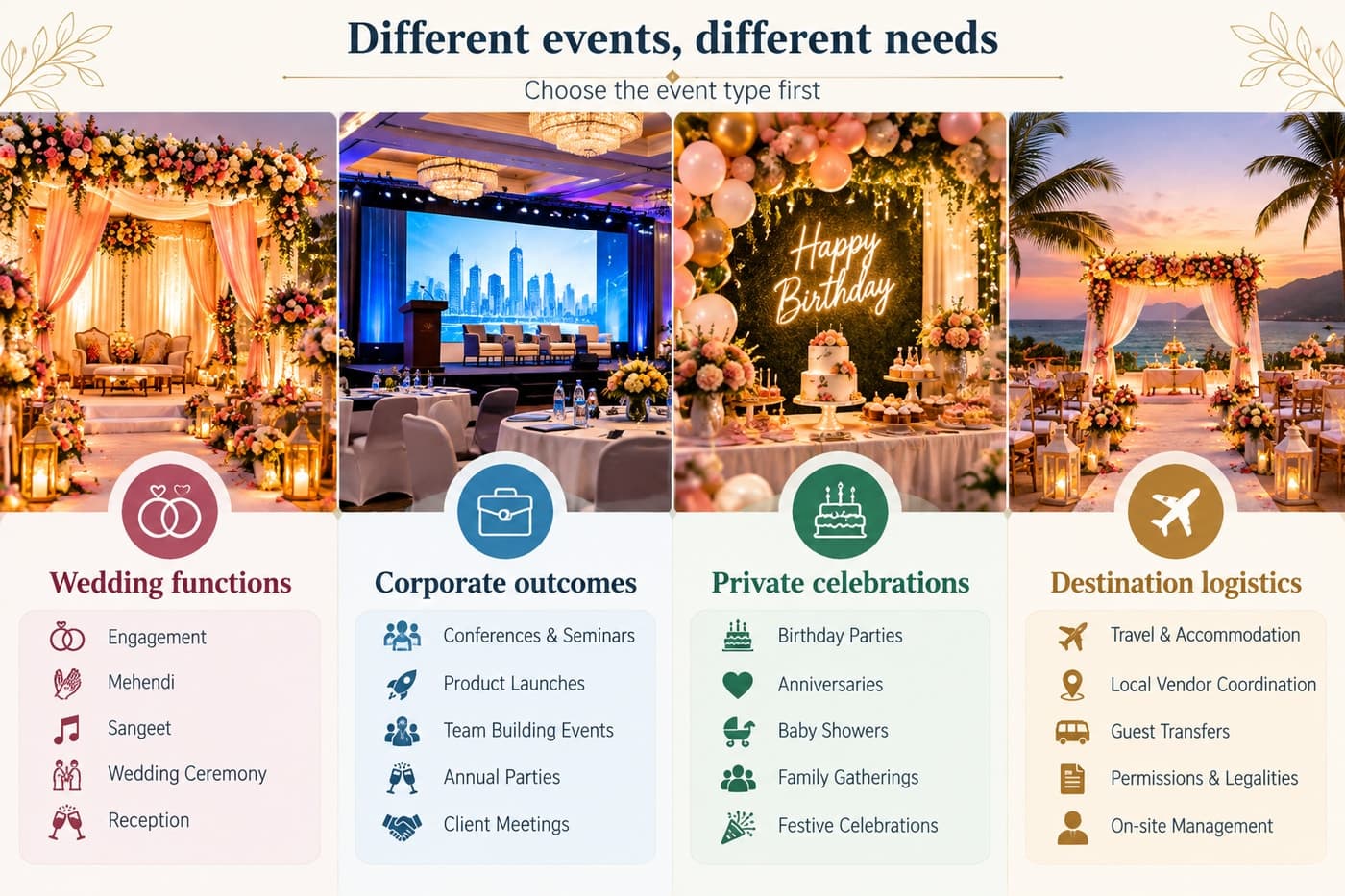
Weddings & Multi-Day Celebrations
Indian weddings frequently comprise multiple ceremonies across several days (Haldi, Mehendi, Sangeet, Wedding Mandap ceremony, and Grand Reception). In your budget planning, treat each ceremony as a distinct sub-event before rolling up shared expenses like venue rent, hotel room blocks, and planner retainers.
Corporate Conferences & Product Launches
Corporate budgets center on brand objectives: stakeholder engagement, lead generation, or employee recognition. Spending focuses on premium tech production (microphones, teleprompters, digital backdrops), delegate registration software, executive catering, keynote speaker logistics, and branded collateral.
Birthdays, Anniversaries & Private Parties
Private celebrations allow hosts to maintain personal connections while strictly bounding complexity. Broad illustrative scenarios like ₹20,000 to ₹1 Lakh for intimate home parties or ₹1 Lakh to ₹5 Lakh for banquet setups are preliminary scoping bands only. Always establish current vendor quotes before committing.
7. How Much Does an Event Planner Charge in India?
An event planner's professional fee compensates for planning expertise, contract negotiations, vendor vetting, run-of-show scheduling, and on-site event execution. It is crucial to understand that an event planner fee is separate from the total event budget unless a written turnkey contract explicitly bundles them.
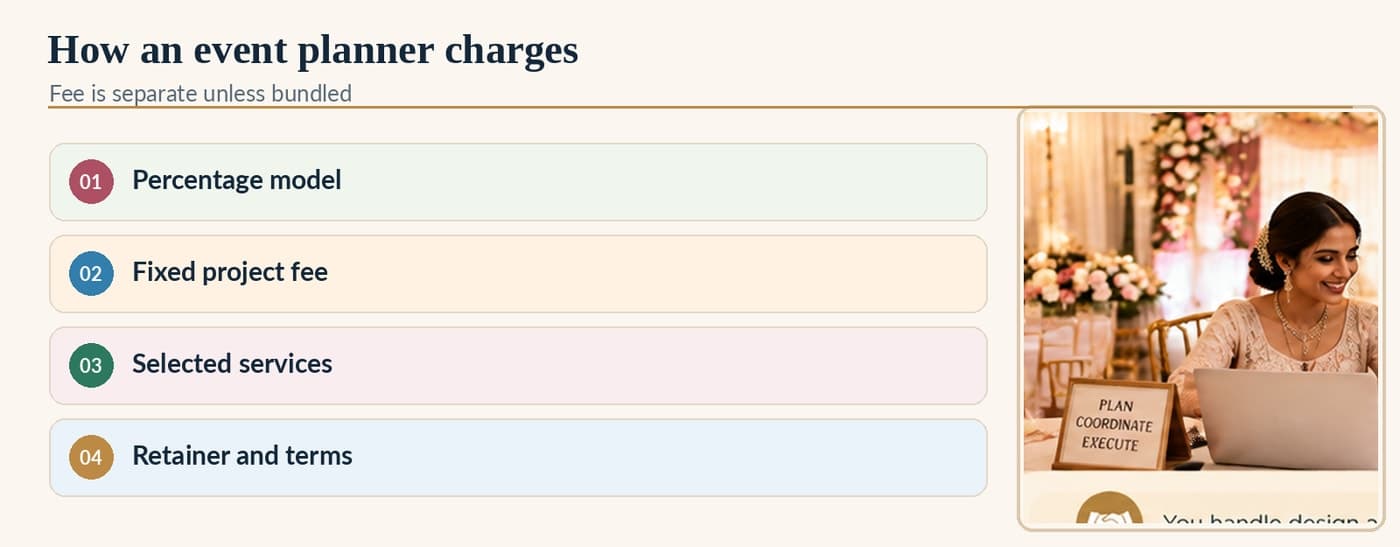
Commonly advertised around 10% to 15% of the overall managed budget for full-scale weddings. Note: This is an example model, not a universal industry standard. Ensure the contract states exactly which expenses (venue rent, guest rooms, liquor) are included in the percentage calculation base.
An agreed lump-sum professional fee for clearly defined scope, deliverables, team size, and event days. Offers financial predictability for hosts whose guest count and ceremony scale are stable.
Ideal for hosts who have already locked their venue and caterer but require professional assistance for décor design, artist bookings, or day-of event coordination.
An advance deposit securing the planner's calendar, followed by milestone disbursements tied to specific deliverables (vendor finalization, floor plans, event day).
8. Example: A ₹10 Lakh Event Planning Budget
To visualize how event funds are allocated, consider a hypothetical mid-sized celebration with a hard ceiling of ₹10,00,000.
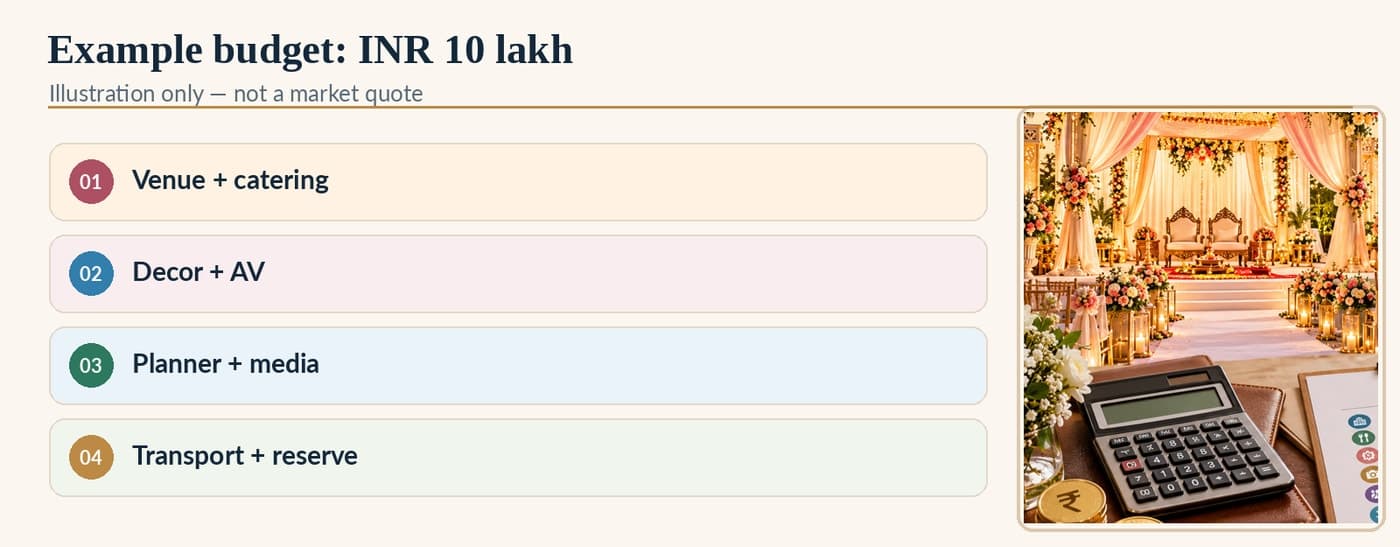
Illustrative ₹10,00,000 Event Budget Breakdown
Hypothetical distribution across 9 core planning categories
| Category | Share (%) | Illustrative Amount |
|---|---|---|
| Venue & Space Rental Banquet hall or lawn rental, basic lighting, power backup, security, and venue housekeeping charges. | 25% | ₹2,50,000 |
| Food, Beverage & Catering Multi-course menu, live cooking counters, dessert displays, service staff, glassware, and tableware rentals. | 30% | ₹3,00,000 |
| Décor, Ambience & Floral Stage backdrop, floral arrangements, entrance arch, table centerpieces, photo booths, and ambient drapery. | 12% | ₹1,20,000 |
| Sound, Lighting & AV Production JBL/line-array speakers, digital audio console, wireless microphones, LED wall, and stage spotlights. | 6% | ₹60,000 |
| Photography & Videography Candid photographer, traditional coverage, cinematic highlights video, teaser reel, and raw master files. | 6% | ₹60,000 |
| Event Planner Professional Fee Dedicated planning team, vendor procurement, budget administration, timeline coordination, and event-day lead. | 8% | ₹80,000 |
| Transport & Guest Logistics Guest shuttles, airport/station pickups, vendor freight transport, and parking coordination. | 4% | ₹40,000 |
| Invitations, Stationery & Admin Digital invitations, printed itineraries, welcome signage, place cards, and administrative expenses. | 3% | ₹30,000 |
| Contingency / Emergency Reserve Dedicated financial buffer for approved unexpected weather alterations, rush rentals, or overtime needs. | 6% | ₹60,000 |
| TOTAL EVENT BUDGET | 100% | ₹10,00,000 |
9. Hidden Event Costs That Can Change the Final Bill
Hidden expenses and surprise surcharges are the primary reasons early event estimates derail. A comprehensive quote audit examines proposals across four distinct layers:
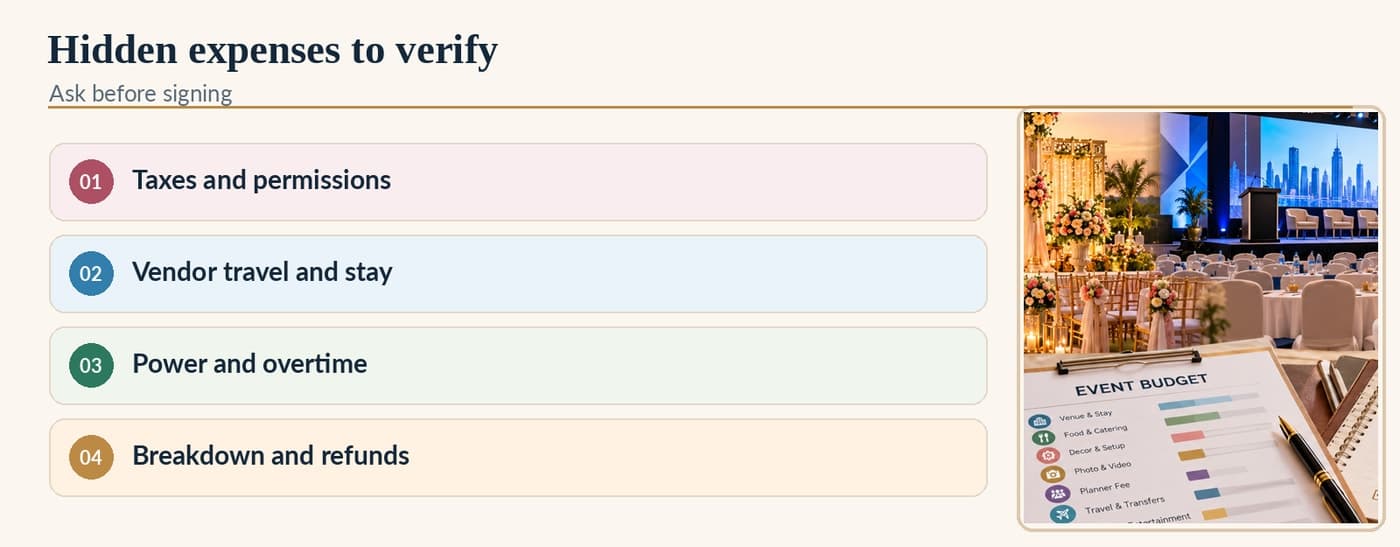
1. Taxes & Statutory Permissions
Confirm whether vendor prices include GST (18% on venue/production, 5% on pure catering). Inquire about music licensing (PPL, IPRS, NOVEX) and local police/fire NOC permits required for amplified music.
2. Vendor Travel & Accommodation
Out-of-city photographers, makeup artists, and DJs require flight tickets, local cab transfers, driver allowances, and crew meal rooms on-site during production hours.
3. Overtime, Fuel & Generator Surcharges
Venues bill steep hourly penalties for late teardown. Diesel generators consume significant fuel during multi-hour high-draw lighting and air-conditioning setups.
4. Security Deposits & Damage Waivers
Venues require refundable caution money (₹25,000 to ₹1,00,000) against potential carpet damage, wall nailing, or delayed load-out. Clarify refund refundability timelines in writing.
10. Track the Budget: Estimate, Quote, Commitment and Actual
An event budget is a living operational control document, not a spreadsheet created once and abandoned. A rigorous framework tracks costs across six progressive financial statuses:
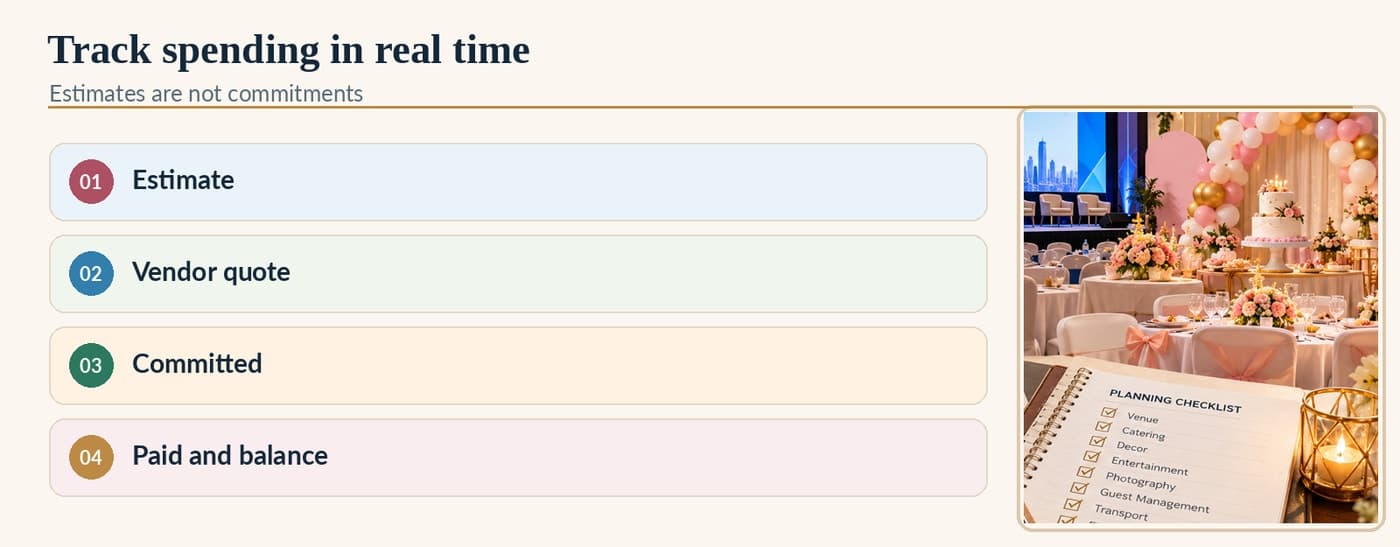
The 6-Stage Real-Time Financial Ledger
Managing Variance: If stage lighting was budgeted at ₹60,000 but the chosen vendor quotes ₹75,000, the ₹15,000 variance must be rebalanced by reducing an optional decor item or formally approving a higher category cap. Never hide variance in an unmonitored miscellaneous line.
11. Ways to Reduce Event Costs Without Losing Quality
Smart cost optimization focuses on what guests truly perceive: delicious hot food, prompt hospitality, crystal clear acoustics, and a warm atmosphere. Trimming expenses should never make the event feel cheap or disorganized:
Strategic Areas to Optimize
- • Non-Peak Dates: Consider weekday evenings or non-peak months for significant venue fee negotiations.
- • Unified Venues: Host ceremonies and banquets within the same resort to eliminate separate transport and repeated setups.
- • Focal Point Décor: Concentrate premium florals on the entrance arch and main stage rather than sparsely dressing vast peripheral areas.
- • Refined Menu Choices: Eliminate low-demand live stations to cut waste and improve kitchen speed.
Never Compromise On These Items
- • Guest Safety & Egress: Never compromise on fire safety, emergency exits, or licensed electrical distribution.
- • Generator Backup: Never risk power failure during key ceremonial moments or high-stakes corporate speeches.
- • Sound Quality: Cheap audio that feeds back or muffles vows will ruin the guest experience instantly.
- • Catering Hygiene: High food hygiene and temperature management are fundamental to guest hospitality.
12. Step-by-Step Event Budget Checklist
A chronological timeline keeps financial decisions structured, avoiding the frantic rushed bookings that inflate vendor charges:
Phase 1: Foundation & Ceiling
6 to 12 Months Before- Define celebration purpose, core guest experience priorities, and spending ceiling.
- Estimate preliminary guest count range across close family, colleagues, and friends.
- Research dates, venue categories (hotel, resort, lawn), and off-peak vs peak availability.
- Draft preliminary category allocations before paying non-refundable deposits.
- Shortlist professional event planners and request scope-specific service proposals.
Phase 2: Vendor Selection & Quoting
3 to 6 Months Before- Send identical written briefs to competing caterers, decorators, and AV suppliers.
- Confirm all proposals itemize taxes (GST), generator fuel, setup hours, and teardown terms.
- Finalize core vendor contracts and lock payment milestone schedules in writing.
- Log every deposit paid in a central tracking sheet with date, invoice number, and remaining balance.
- Review catering per-plate formulas and confirm minimum guaranteed guest commitments.
Phase 3: Headcount Lock & Variance Audit
1 to 3 Months Before- Finalize RSVP confirmations and establish final guaranteed headcounts for catering and seating.
- Compare contracted vendor commitments against initial category estimates to measure variance.
- Reallocate surplus from under-budget categories to balance any approved scope upgrades.
- Confirm emergency contingency approval protocol (who holds authority to release reserves).
- Detail weather contingency plans and indoor backup spaces with venue management.
Phase 4: Execution & Financial Settlement
Final Week & Event Day- Reconfirm load-in access hours, delivery timing, sound restrictions, and municipal permissions.
- Distribute final master run-of-show and vendor emergency contact sheet to key stakeholders.
- Assign an authorized point person to verify on-site deliverables before signing completion dockets.
- Disburse scheduled final milestone payments upon verified performance.
- Reconcile invoices post-event, close outstanding security deposits, and archive receipts.
13. Questions to Ask Before Hiring an Event Planner
A quote is only meaningful when you know precisely what it covers. Before signing an event management agreement, interview candidates across three critical accountability pillars:
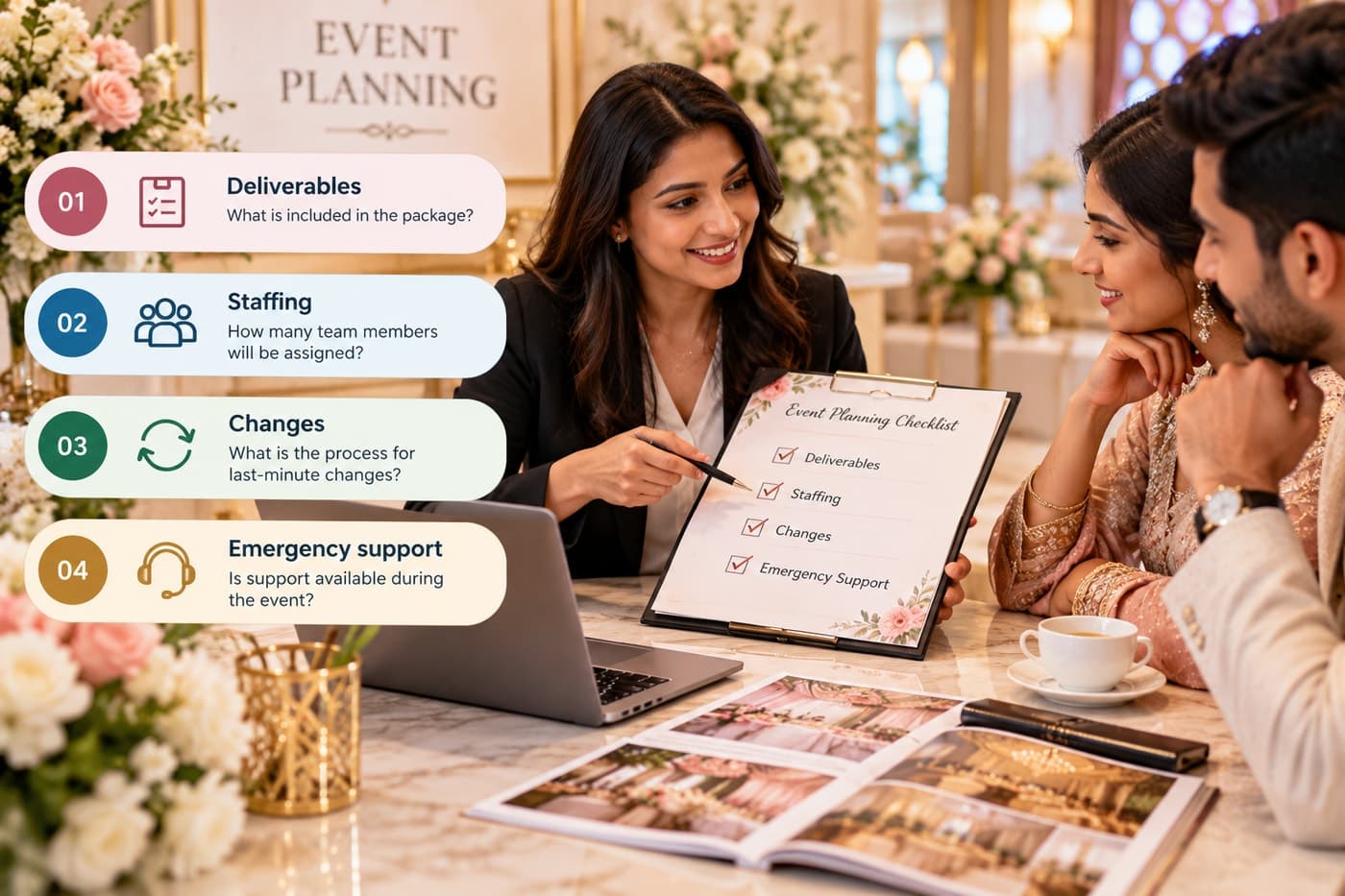
1. Deliverables & Staffing
- • Will there be a dedicated on-site event lead throughout production?
- • Exactly how many crew members will manage guest hospitality and cueing?
- • What specific stages (design, sourcing, on-day) are covered in the fee?
2. Procurement & Invoices
- • Do you share original vendor invoices directly with the client?
- • Do you accept supplier commissions or referral kickbacks?
- • Can the client independently approve or replace recommended suppliers?
3. Financial Reporting
- • How frequently is the central budget ledger shared and updated?
- • What formal approval process is required before committing extra spend?
- • What is the protocol and backup plan for weather or vendor defaults?
14. Frequently Asked Questions
Straightforward answers to the most common questions regarding event planning investments, budgeting, and fee structures in India:
15. Conclusion: Plan the Experience, Not Just the Price
The right answer to how much event planning costs in India is never a single static number. It is a structured, transparent financial roadmap built around your occasion, your aesthetic vision, your guest count, and your defined spending ceiling.
By prioritizing essential guest experiences, requesting comparable itemized written proposals, keeping the professional planner fee clearly identified, and tracking expenses from estimate through to actual execution, you ensure that every rupee spent delivers meaningful hospitality and memorable moments.
Explore Related Event Planning Resources
Continue organizing your celebration with our practical planning guides:
Need Help Building a Realistic Event Plan and Budget?
Share your event vision, guest count, city, and priorities with AS Event Management. Our team can help you build a clear, transparent planning scope and realistic budget roadmap tailored to your celebration.